

What are the different types of transformer oil level sensors? Principles of float-type, pressure-type, and remote oil level monitoring
Date: September 29, 2026, 09:35:35
Transformer oil level sensors are used to detect changes in the oil level in the tanks of oil-immersed transformers, oil storage tanks, or related oil systems, and to transmit this information for on-site display, remote transmission, low-oil-level alarms, or comprehensive online monitoring.
In actual engineering applications, the term “transformer oil level sensor” does not refer to just one type of product. Depending on their structure and signal transmission methods, they can be classified into float-type, mechanical pointer-type, pressure-type, and magnetic level sensors, as well as smart oil level sensors with remote output options such as 4–20 mA and RS-485.
- Float-type:The float generates mechanical displacement as the oil level changes.
- Mechanical analog:The float's position is converted into a dial reading via a transmission mechanism.
- Remote-type:Add an electrical signal output based on the mechanical oil level.
- Pressure-type:The oil level is calculated indirectly based on the pressure of the liquid column.
- Smart Oil Level Monitoring:It can output signals such as 4–20 mA and RS-485 for integration into a comprehensive online monitoring system.
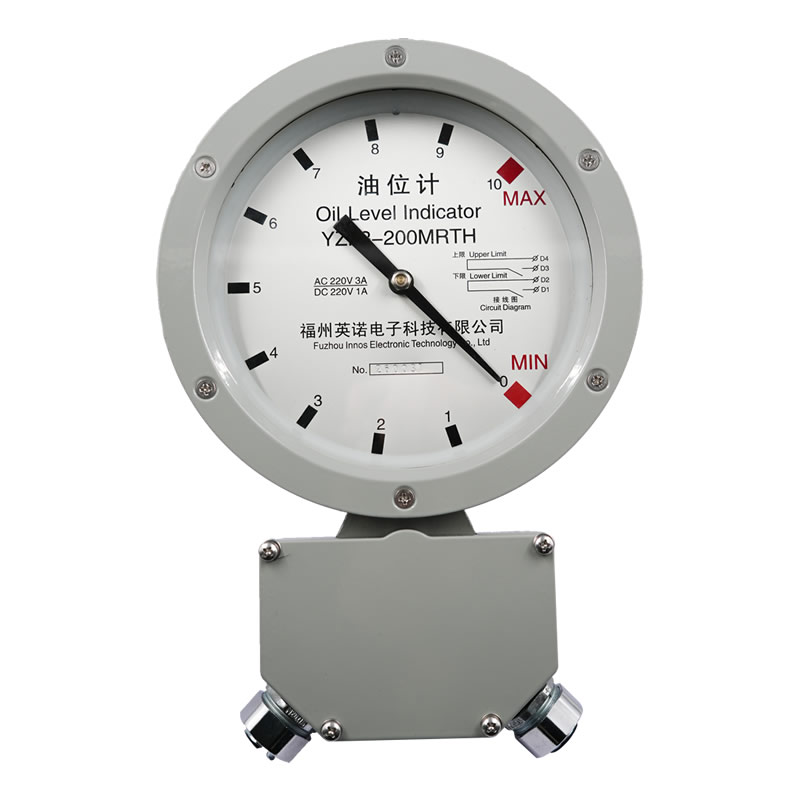
Innotongda can supply transformersoil level meter, remote oil level gauges, and comprehensive online monitoring solutions for oil temperature, oil level, and oil pressure. For related products, please refer toTransformer oil level monitoring deviceThe
I. Why Is It Necessary to Monitor the Oil Level in a Transformer?
In oil-immersed transformers, the insulating oil serves both as insulation and for heat dissipation; therefore, changes in the oil level directly affect the equipment's operating condition.
Under normal circumstances, transformer oil expands and contracts with changes in temperature, so the oil level is not always constant.
If the oil level is abnormally low, abnormally high, or does not correspond to temperature changes over an extended period, further inspection is required.
Common causes include:
- Oil leakage from the transformer;
- Sealing system malfunction;
- The amount of oil added is inappropriate;
- Abnormalities in the oil reservoir or capsule system;
- The oil level gauge is stuck;
- Float mechanism malfunction;
- Changes in oil temperature;
- Abnormal sensor or remote signal.
II. Where are transformer oil level sensors typically installed?
The specific installation location depends on the transformer's design.
Common locations include:
- Oil storage tank;
- Main fuel tank liquid level measurement location;
- Separate oil chamber for the on-load tap changer;
- casing or other standalone oil-filled components;
- Pressure taps or measurement ports for integrated online monitoring.
For oil-immersed transformers equipped with an oil reservoir, oil level measurement typically focuses on changes in the oil level within the reservoir.
III. How Does a Float-Type Transformer Oil Level Sensor Work?
Float-type oil level sensors are the most common type.
The basic principle is:
Changes in oil level → The float moves up or down → The connecting rod or magnetic mechanism moves → This is converted into a mechanical indication or an electrical signal.
When the transformer oil level rises, the float rises with the liquid level; when the oil level drops, the float drops accordingly.
The advantages of this design are that its operating principle is intuitive, its mechanical structure is well-established, and it can be combined with an on-site pointer display.
IV. What is the difference between a mechanical pointer-type oil level gauge and an oil level sensor?
While there is some overlap between the two concepts, they focus on different aspects.
Mechanical Pointer-Type Oil Level GaugeIt places even greater emphasis on on-site visual readings.
Oil Level SensorIt places greater emphasis on converting changes in oil level into a signal that can be detected.
Modern remote oil-level gauges typically combine both approaches:
- There are mechanical hands on the dial;
- Contains a float or a magnetic drive mechanism;
- Simultaneously outputs 4–20 mA, digital I/O, or digital communication signals.
Therefore, the “remote oil level gauge” commonly found in engineering procurement is, in essence, an oil level monitoring device that integrates mechanical display and sensor output.
V. How Do Pressure-Type Oil Level Sensors Measure Oil Level?
Pressure-type oil level sensors indirectly calculate the oil level based on the relationship between the hydrostatic pressure of the liquid and the height of the liquid column.
Under certain conditions, the pressure at the bottom of a liquid is related to the height of the liquid column.
The basic idea can be understood as follows:
Measure the pressure of the oil column → Based on the oil's density and structural parameters → Convert to the actual oil level.
The advantages of the pressure-based solution are:
- No complex mechanical float-driven mechanism;
- Easy to convert into an electrical signal;
- Suitable for integration into a comprehensive online monitoring system.
However, it also needs to take into account:
- Changes in oil temperature;
- Changes in oil density;
- Installation height;
- Pressure tap locations;
- Zero-point drift in pressure sensors.
VI. What is the difference between float-type and pressure-type oil level sensors?
| Comparison Items | Float | pressure-based |
|---|---|---|
| Measuring principle | Buoyancy and Mechanical Displacement | Hydrostatic Pressure of a Liquid Column |
| On-Site Instructions | Easy to implement a mechanical analog display | An electronic display is usually required |
| Moving Parts | Equipped with a float and a drive mechanism | Fewer moving parts |
| Remote Output | A transmitter module can be added | It is easier to output standard signals directly |
| Key Factors | Mechanical Jamming, Float Status | Temperature, Density, and Pressure Sensor Status |
| typical application | Oil Level Gauge for Oil Storage Tanks | Integrated Online Level Data Acquisition |
VII. What Is a Remote Oil Level Gauge for Transformers?
A remote oil level gauge adds remote signal output functionality to a traditional on-site oil level display.
It allows you to view the oil level on-site and also upload the oil level signal to:
- Substation Back Office;
- Integrated Online Monitoring System;
- PLC;
- RTU;
- Smart Monitoring Terminal.
Common remote transmission methods include:
- 4–20 mA;
- 0–5 V or 0–10 V;
- Digital signals;
- RS485;
- Modbus RTU.
The specific output format depends on the product model.
For example, seeYZF3-200 Remote Oil Level GaugeThe
VIII. How does a 4–20 mA oil level sensor work?
4–20 mA is a common analog signal in industrial field applications.
The oil level sensor converts the actual oil level into a corresponding current. For example:
- A low oil level corresponds to approximately 4 mA;
- A high oil level corresponds to approximately 20 mA;
- The oil level in the middle changes proportionally.
The backend system converts the 4–20 mA signal into a percentage or the actual oil level.
The advantages of this approach include:
- Good resistance to interference;
- Suitable for longer-distance transmission;
- Easy integration with PLCs and monitoring systems;
- The signals are highly standardized.
IX. What are the advantages of the RS485 oil level sensor?
RS-485 is a digital communication protocol.
Compared to 4–20 mA, RS-485 can not only transmit a single oil level value but also upload additional information depending on the device’s design, such as:
- Real-time oil level;
- Alarm status;
- Equipment failure status;
- Sensor status;
- Device address;
- Selected diagnostic information.
If the Modbus RTU protocol is used, it also makes it easy to connect to a bus with multiple devices.
10. Why does the oil level sensor also monitor oil temperature?
This is because transformer oil exhibits significant thermal expansion and contraction.
When the oil temperature rises, the oil typically expands, causing the oil level to rise; when the oil temperature drops, the oil level may fall.
Therefore, if you only observe changes in the oil level without knowing the oil temperature, it is easy to misjudge the situation.
For example:
- During periods of high load in the summer, an increase in oil level may be due to normal thermal expansion;
- A drop in oil level during cold winter temperatures may also be normal;
- If the oil temperature remains essentially unchanged but the oil level continues to drop, you should focus on checking for oil leaks or inspecting the measurement system.
Therefore, it is best to analyze oil level data in conjunction with oil temperature data.
XI. What are the possible causes of low oil levels?
When the transformer oil level is significantly below the normal range, you can troubleshoot the issue by considering the following:
1. Oil Leak
Check for leaks at flanges, valves, welds, radiators, sleeves, and sealing areas.
2. The ambient or oil temperature is too low
Low temperatures cause the oil to contract, resulting in a drop in the oil level.
3. Insufficient oil replenishment
Insufficient oil replenishment after maintenance or an oil change can also lead to a persistently low oil level.
4. Stuck oil level gauge
The actual fuel level may be normal, but a jammed float, connecting rod, or pointer mechanism can also cause a false low fuel reading.
5. Remote Signal Abnormality
If the mechanical gauge on-site is functioning normally but the system displays an error, you should focus on checking the sensors, transmitters, wiring, and range settings.
12. What causes the oil level to be too high?
An abnormally high oil level may be related to the following factors:
- Excessive oil temperature causes volumetric expansion;
- Excessive oil application;
- Abnormal internal structure of the oil storage tank;
- Abnormalities in the capsule or diaphragm system;
- The mechanical oil level gauge is stuck in the high position;
- The remote transmission range is set incorrectly.
Therefore, neither high nor low oil levels should be determined based solely on the gauge reading; they must be assessed in conjunction with the oil temperature and the actual condition of the equipment.
13. What is a false oil level?
The term “false oil level” refers to a situation where the oil level gauge reading does not match the actual oil level.
Common causes include:
- The float is stuck;
- The drive mechanism is sticking;
- Abnormal magnetic coupling mechanism;
- The pointer is loose;
- Sensor malfunction;
- Error in remote signal conversion;
- Incorrect range setting.
If you find that the oil level at the site does not match the data from the backend system, you should check both the mechanical display and the electrical remote transmission systems separately.
14. How can you tell if the oil level has actually dropped or if the sensor is malfunctioning?
You can troubleshoot in the following order:
- Check the on-site mechanical oil level gauge;
- Compare with the remote oil level data from the backend;
- Check the oil temperature;
- Check for oil leaks;
- Check the sensor's output signal;
- Verify that the 4–20 mA or RS-485 data is normal;
- Check the measurement range and zero point settings.
If both the mechanical gauge and the remote reading show a drop, and there are signs of an oil leak on-site, it is more likely that the actual oil level has dropped.
If the mechanical clock is stable but the remotely transmitted data shows abnormal fluctuations, the sensors and signal links should be checked first.
15. Can an oil level sensor be connected directly to a PLC?
Yes, but we need to confirm the PLC input type.
For example:
- 4–20 mA oil level sensor → Connects to the PLC analog input module;
- RS485 Oil Level Sensor → Connects to the PLC's serial port or communication module;
- High/low oil level switch signals → Connect to a digital input module.
Before connecting the wires, make sure to:
- Supply voltage;
- Input type;
- Measurement range;
- Mailing Address;
- Agreement;
- Grounding and Shielding Requirements.
16. Can an alarm be set for the transformer oil level sensor?
Oil level alarms can be configured via a local device or the backend system.
Common alerts include:
- Low oil level warning;
- Low oil level alarm;
- High oil level alarm;
- Sensor failure alarm;
- Communication Interruption Alarm.
Specific alarm thresholds cannot be set uniformly; they should be determined based on the transformer’s design, the oil level gauge scale, the manufacturer’s specifications, and operating procedures.
17. What is the difference between a transformer oil level sensor and a three-in-one device that measures oil temperature, oil level, and oil pressure?
A standalone oil level sensor only addresses liquid level measurement, whereas a three-in-one monitoring device can simultaneously measure:
- Oil temperature;
- Oil level;
- Hydraulic pressure.
For new digital substations, containerized substations, or projects requiring a reduction in the number of individual sensors, the three-in-one device can minimize wiring and communication nodes.
See the product for referenceTransformer oil temperature - oil level - oil pressure three-in-one monitoring deviceThe
18. What is the difference between oil level and oil pressure?
The oil level indicates the height of the liquid or the amount of liquid present.
Hydraulic pressure indicates the pressure conditions within the hydraulic system.
Although pressure-based level measurement can indirectly determine the oil level based on pressure, “oil level” and “oil pressure” are still two distinct monitoring parameters.
In integrated online monitoring, the two systems can provide each other with supplementary information for decision-making.
19. What is the relationship between the oil level sensor and the oil reservoir capsule?
Some oil-immersed transformers use capsules or other isolation structures inside the oil reservoir to isolate the insulating oil from the outside air.
This design affects the arrangement of the float and the oil level gauge.
Therefore, when replacing an oil level gauge or sensor, you should not select one based solely on the dial size; you must also verify the following:
- Structure of an Oil Storage Tank;
- Install the flange;
- Float length;
- Rotation direction;
- Measurement range;
- Interior.
20. How do you read the scale on a transformer oil level gauge?
Different oil level gauges may use:
- MIN / MAX;
- Percentage scale;
- Temperature scale;
- Partition Indication;
- High and low oil level marks.
Not all oil level gauges should be considered ordinary 0-100% level gauges.
Some oil level gauges for oil storage tanks are designed to account for changes in oil temperature; therefore, when taking readings, you should refer to the equipment nameplate and the oil level gauge manual.
21. Why do oil level gauges have temperature scales?
This is because the normal oil level itself fluctuates with changes in oil temperature.
Some mechanical oil level gauges feature temperature-dependent reference marks to help operations and maintenance personnel determine whether the current oil level corresponds to the oil temperature.
For example, for the same amount of oil, the liquid level varies under low- and high-temperature conditions.
Therefore:
When determining whether the oil level is normal, you should take temperature compensation into account rather than simply checking whether the needle is at a specific position.
22. Why is there a discrepancy between the remote oil level reading and the on-site gauge?
Possible causes include:
- Zero-point drift in the transmitter module;
- The mechanical transmission is out of sync with the electrical signal conversion;
- Incorrect 4–20 mA range setting;
- PLC conversion parameter error;
- Communication data mapping error;
- The mechanical hands on the instrument panel are loose;
- Sensor aging.
During debugging, you should record the following:
- Current pointer position;
- Actual output current;
- The backend displays percentages.
Then check them one by one.
23. What should be kept in mind when installing an oil level sensor?
When installing or replacing, we recommend paying close attention to the following:
- Installation location and orientation;
- Flange installation dimensions;
- Seal reliability;
- Does the float move freely?;
- Sensor range;
- Direction of the on-site pointer;
- Power Supply Method;
- Remote Signal Types;
- Cable shielding;
- Backend range settings.
For oil-immersed transformers in operation, any disassembly or reassembly involving the oil system must also be carried out in accordance with on-site maintenance and oil treatment procedures.
24. Can remote oil level monitoring be added to an existing transformer?
Yes, but it depends on the structure of the crude oil level gauge and the conditions for the modification.
Common renovation approaches include:
- Replace it with an oil level gauge with a remote output;
- Add a separate oil level sensor;
- Add a signal transmission module;
- Connect to the existing integrated online monitoring host.
Before making any modifications, you need to confirm the following:
- Crude Oil Level Gauge Model;
- Installation Dimensions;
- Structure of an Oil Storage Tank;
- On-site power supply;
- Communication interfaces;
- Back-end system.
25. What parameters should be confirmed when selecting a transformer oil level sensor?
| Selection parameters | Items to Confirm |
|---|---|
| Transformer type | Main transformers, distribution transformers, prefabricated substations, etc. |
| mounting position | Oil reservoir, main oil tank, or separate oil chamber |
| Measuring principle | Float-type, pressure-type, or other |
| mounting interface | Flanges, Threads, and Dimensions |
| Measurement range | Range of Actual Oil Level Variations |
| output signal | 4–20 mA, RS-485, digital inputs, etc. |
| On-site Display | Are mechanical hands required? |
| give a warning | Are high and low oil level contacts required? |
| communications protocol | Modbus RTU or Project Protocol |
| environmental conditions | Temperature, Protection, and Indoor/Outdoor Use |
26. What are the common malfunctions of transformer oil level sensors?
Common problems include:
- The float is stuck;
- The mechanical hands are not moving;
- Display remains fixed in one position;
- Sudden changes in oil level;
- No 4–20 mA output;
- The output remains constant when it reaches full scale;
- RS485 communication interrupted;
- There is a significant discrepancy between the on-site and backend values;
- False alarms for high and low oil levels.
27. How do you troubleshoot an oil level sensor malfunction?
You can follow this order:
- Check the actual oil level and on-site gauges;
- Inspect the sensor's mechanical structure;
- Check the power supply;
- Measure the output signal;
- Check the wiring and terminals;
- Check the communication addresses and parameters;
- Verify the range conversion in the backend;
- Calibrate the sensors as needed.
28. Frequently Asked Questions (FAQ)
Are transformer oil level sensors and oil level gauges the same thing?
They are not exactly the same. Level gauges emphasize on-site display, while level sensors emphasize signal acquisition. Many remote level gauges offer both functions.
Why isn't the oil level in a transformer fixed?
Because insulating oil expands and contracts with temperature changes, the normal oil level will vary with oil temperature and load.
Can an oil level sensor output 4–20 mA?
Yes, you’ll need to select a model with the appropriate remote transmission capabilities.
Can the oil level sensor output RS-485?
Some smart oil level monitoring devices support protocols such as RS485 and Modbus RTU; specific support depends on the product configuration.
Does a low oil level in a transformer always mean there's an oil leak?
Not necessarily. Low temperatures, insufficient oil replenishment, a stuck oil level gauge, or a malfunction in the remote signal can also cause a low oil level or a false low oil level reading.
Can a transformer be shut down immediately if the oil level is abnormal?
A decision should first be made based on the actual oil level, equipment status, alarm level, and on-site operating procedures. Operational decisions should not be made solely based on a single piece of remote data.
Are float-type oil level sensors prone to jamming?
Mechanical components may become seized after prolonged operation; therefore, a judgment must be made based on a combination of on-site readings, remote data, and maintenance inspections.
Is pressure-based oil level monitoring accurate?
Pressure-based solutions can be used for liquid level monitoring, but their accuracy is affected by the installation location, oil density, temperature, and sensor performance, and requires proper compensation and calibration.
Can an old transformer be retrofitted with a smart remote oil level sensor?
Modifications can be made based on the crude oil level gauge interface and the oil storage tank structure, but the installation dimensions, output interfaces, and power-off construction conditions should be confirmed first.
29. Innotongda Transformer Oil Level Monitoring Solution
Based on the structure of oil-immersed transformers and existing monitoring systems, Innotongda can provide mechanical oil level gauges, remote oil level gauges, oil level sensors, and comprehensive online monitoring solutions.
Related Products and Technology Pages:
- Transformer oil level monitoring device
- YZF3-200 Remote Oil Level Gauge
- Transformer oil temperature - oil level - oil pressure three-in-one monitoring device
- Remote Oil Level Monitoring for the Main Transformer
When requesting a quote for a project or upgrading existing equipment, we recommend providing photos of the existing level gauge, its model number, installation dimensions, the structure of the storage tank, the required output signals, and any back-end communication requirements to help determine the appropriate level monitoring solution.
Assessments of transformer oil levels should be made in conjunction with oil temperature and historical trends. A rise or fall in oil level on its own does not necessarily indicate a fault; however, abnormal relationships between oil level and temperature, a sustained decline in oil level, or long-term discrepancies between mechanical readings and remote data warrant closer inspection.
Note: Installation and calibration methods may vary depending on the transformer manufacturer, oil tank design, and oil level gauge model. Actual installation dimensions, alarm ranges, signal definitions, and criteria for normal oil levels should be determined based on the equipment drawings, the oil level gauge manual, and on-site operating requirements.