transformersOnline monitoring systems — Transformer Condition Monitoring and Fault Early Warning Solution
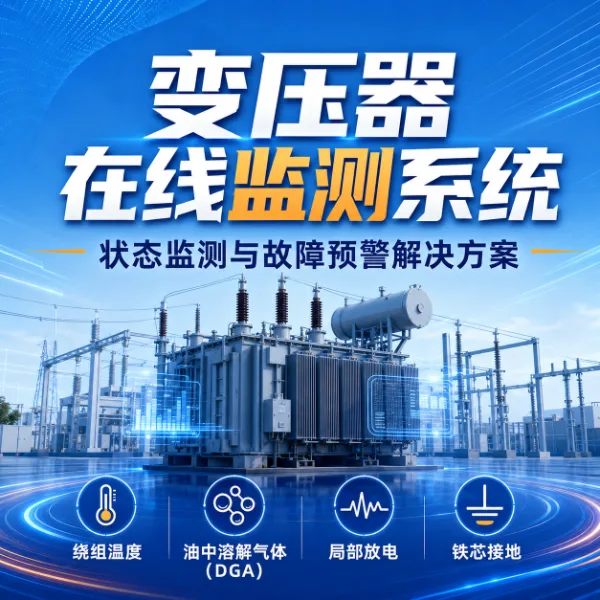
Transformer online monitoring systemIt provides comprehensive monitoring of parameters such as winding temperature, dissolved gas analysis (DGA), partial discharge, core clamp grounding current, DC bias, and on-load tap changers. Through sensors and intelligent algorithms, it enables transformerstate maintenancetogether withearly warning of malfunction... and is widely used in power systems at substations, power plants, new energy power stations, and industrial enterprises.
What is a transformer condition monitoring system?
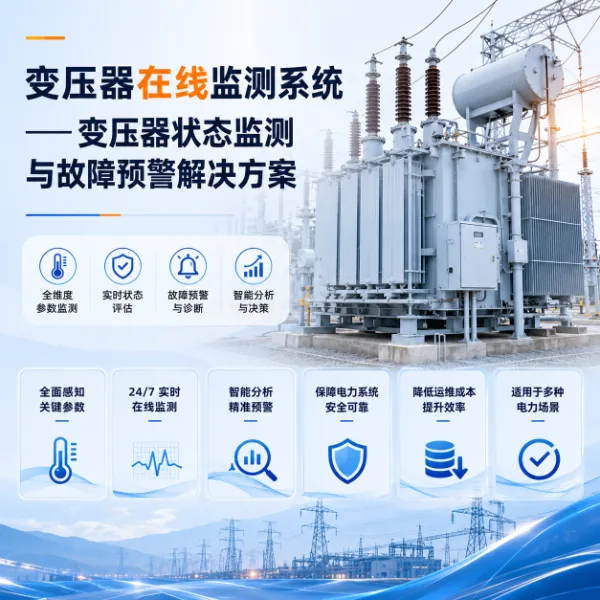
Transformer Condition Monitoring SystemThis is an online monitoring system that uses sensors and data acquisition units deployed at key locations within a transformer to continuously collect, transmit, and intelligently analyze parameters such as winding temperature, dissolved gases in oil, partial discharges, grounding current of the core clamps, DC bias, and the operating status of the on-load tap-changer, 24 hours a day.
Unlike traditional periodic offline inspection methods, this system provides real-time monitoring of transformer operating conditions and issues early warnings at the earliest stages of a fault, enabling substations, power plants, renewable energy power stations, and industrial enterprises to achievestate maintenance, a core tool for reducing O&M costs and ensuring the safe and stable operation of the power system.
- 24-hour continuous online monitoring provides early warnings at the first sign of a fault, helping to prevent sudden power outages.
- Installation without power outages and no need for regular manual inspections, significantly reducing labor and time costs for operation and maintenance
- Multi-parameter data fusion analysis accurately distinguishes between fault types such as overheating, arcing, and insulation aging.
- Supports remote centralized monitoring and historical data trend analysis to aid in condition-based maintenance decision-making
- Can integrate with SCADA and power dispatch platforms, enabling seamless data sharing with existing systems
Transformer Online Monitoring Product Categories — Comprehensive Coverage of Temperature, Oil Chromatography, Partial Discharge, Core, and Switching Systems
The product line covers five major categories: thermal environment, electrical and structural safety, partial discharge, gas-in-oil analysis, and comprehensive diagnostic platforms. These can be flexibly selected and combined for deployment based on the transformer’s voltage rating, operating environment, and monitoring requirements.
Intelligent Operation and Maintenance System for Transformers with Temperature and Environmental Monitoring
Monitoring basic operational parameters—such as winding temperature, core temperature, ambient temperature and humidity, vibration, and oil temperature, oil level, and oil pressure—constitutes the foundational layer of intelligent transformer operation and maintenance.
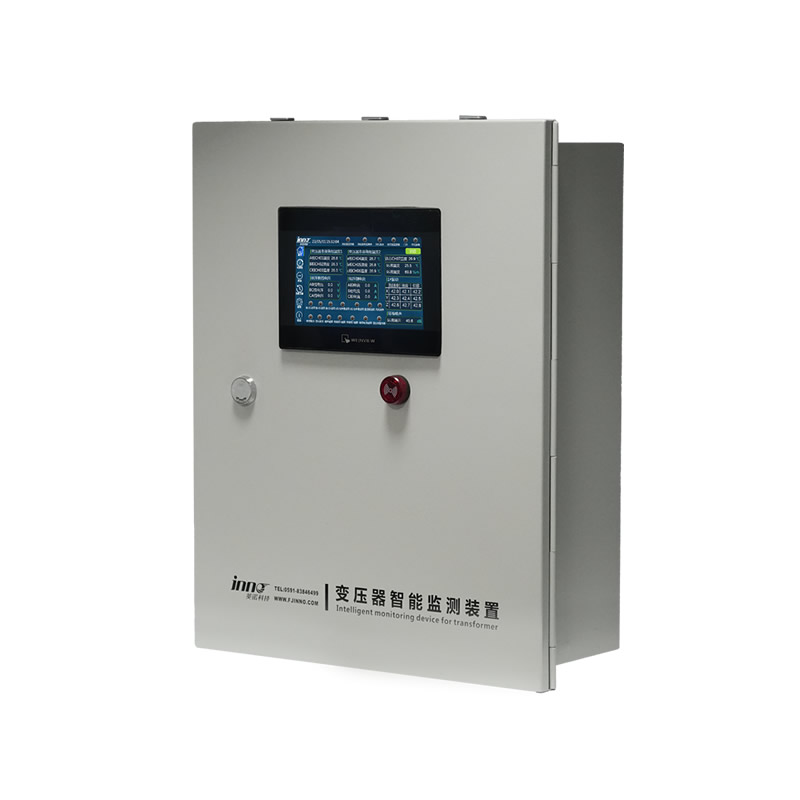
A comprehensive, multi-parameter online monitoring solution designed specifically for dry-type transformers, covering winding and core temperatures, electrical parameters, ambient temperature and humidity, vibration monitoring, and life prediction.
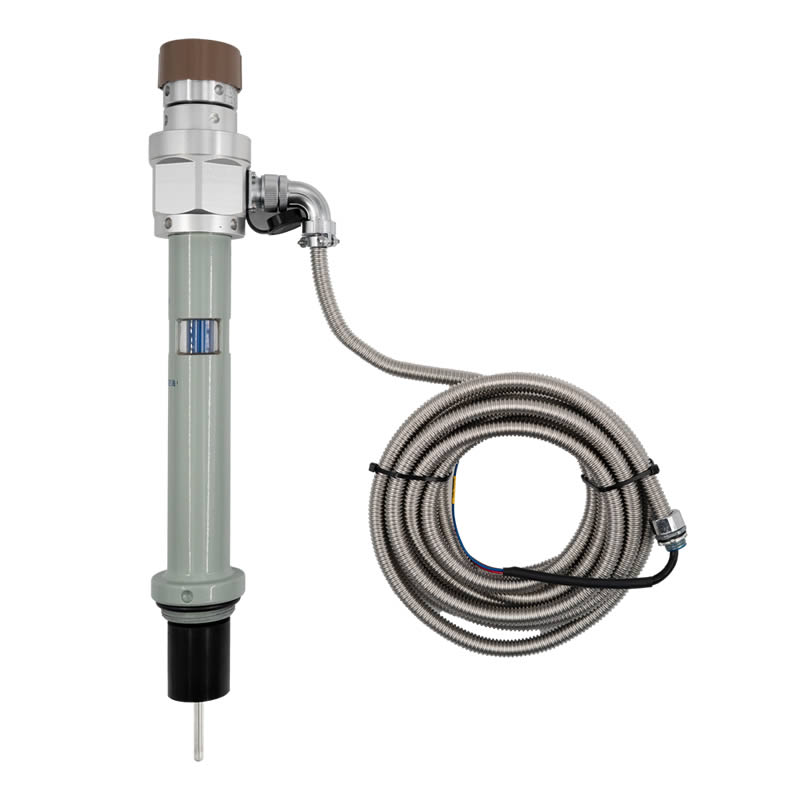
The IB-YKTCF-OL/OP model is specifically designed for oil-immersed transformers and modular substations, providing precise, real-time monitoring of temperature, oil level, and pressure, with an IP68 protection rating.
Transformer Electrical Characteristics and Structural Safety Monitoring System
Monitor electrical and mechanical parameters such as the grounding current of the core clamps, DC bias, and the operating status of the on-load tap changer to promptly detect latent faults such as multipoint grounding of the core, overheating due to magnetic bias, and wear on switch contacts.

Model IN-203: Real-time monitoring of ground currents in cores and clamps (1 mA to 10 A), accurately detecting potential hazards from multi-point ground loops; available for wall-mounted or rack-mounted installation.

The IN-203X model adds an automatic four-stage current-limiting resistor switching function to its ground current monitoring capabilities, providing a rapid response to suppress ground currents.

Model IN-204: Captures neutral-point DC and core magnetic flux density data; monitors DC bias levels 24 hours a day; triggers automatic alarms when thresholds are exceeded.
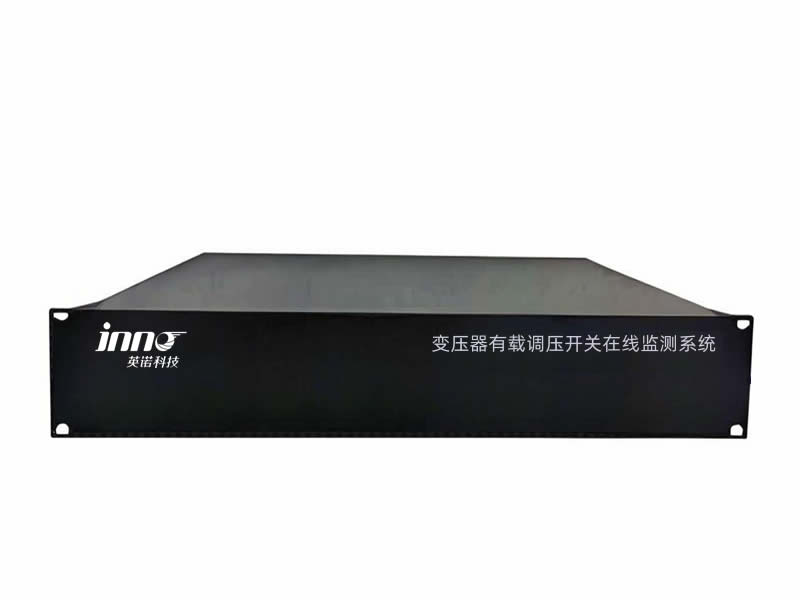
The IN-309F model provides real-time monitoring of key parameters such as switch current, temperature, vibration, and gear position, with a response delay of just 0.5 seconds, and supports cloud-based management.
Online Monitoring System for Transformer Bushing Insulation and Partial Discharges
Using multi-sensor fusion technology—including ultrasound, high-frequency current, and ultra-high frequency—the system monitors the insulation performance and internal partial discharge conditions of the bushing to provide early warnings of insulation defects.
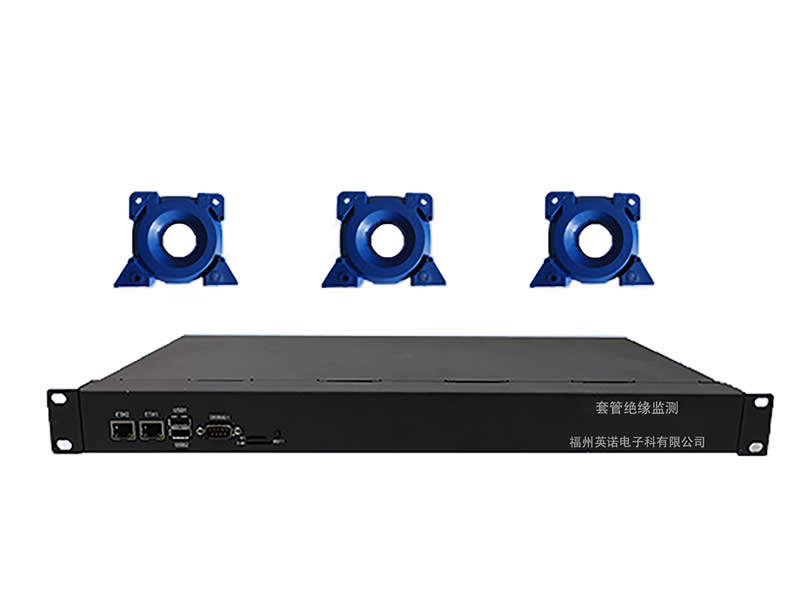
The IN-205B series includes multiple models for insulation testing, partial discharge testing, and combined insulation and partial discharge testing, with a full-current measurement range of 2 mA to 1,000 mA and a dielectric loss factor range of 0.001 to 0.3.
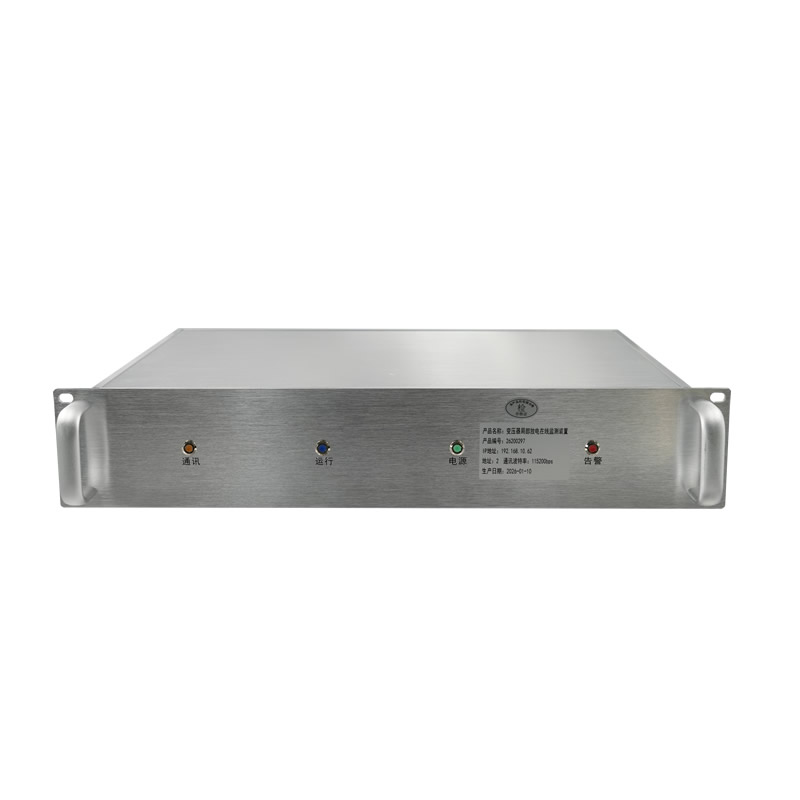
Ultrasonic, high-frequency current, and ultra-high-frequency multi-sensor fusion technologies; 3D PRPD maps provide a visual representation of discharge amplitude and phase; 4- or 6-channel options available.
Online Gas Analysis and Monitoring System for Transformer Oil (DGA)
The online monitoring of the composition and concentration of dissolved gases in transformer oil using various technical approaches—such as gas chromatography, photoacoustic spectroscopy, and electrochemistry—is a key method for identifying fault types such as internal overheating and electrical discharge.

Full-component online analysis provides real-time monitoring of seven characteristic gases—H₂, CO, CO₂, CH₄, C₂H₆, C₂H₄, and C₂H₂—with a sampling interval of as fast as 2 hours per sample.

The IN-201C model focuses on monitoring key gases such as H₂, CO, C₂H₂, and C₂H₄. It features a wall-mounted, all-in-one design and does not require periodic replacement of the carrier gas.

The IN-201G model, based on the principle of photoacoustic spectroscopy, monitors seven target gases without the need for separation or carrier gas, and performs automatic quantitative analysis of the sample.

Model IN-201D, requires no degassing module, responds quickly to dissolved hydrogen (≤30 min), features an integrated design, and is maintenance-free throughout its entire lifecycle.
Comprehensive Online Monitoring and Intelligent Diagnostic Analysis Platform for Transformers
By integrating data from multiple devices and parameters, this solution uses edge computing and intelligent algorithms to perform health assessments of transformers throughout their entire lifecycle, making it suitable for large substations and digital operations and maintenance scenarios.

The IN-200 model simultaneously monitors multiple parameters, including partial discharge, ground current, vibration, load, and oil temperature, and features built-in condition assessment and health index models.

The IN-6000+ is a fully domestically developed, secure, and controllable SCADA platform that supports edge computing, partial discharge spectrum analysis, and a transformer intensive care system.
Guide to Selecting an Online Transformer Monitoring System — How to Choose the Right Monitoring Solution
Different voltage levels, operating environments, and O&M requirements call for different monitoring priorities. The following is a reference guide to common scenarios and recommended monitoring dimensions:
| application scenario | Recommended Monitoring Dimensions | Key Points |
|---|---|---|
| Dry-Type Transformer / Distribution Room | Winding temperature, ambient temperature and humidity, vibration | Overheating Alert, Fan Interlock |
| Oil-immersed Main Transformers / Large Substations | Dielectric Gas Analysis (DGA), Bushing Insulation, Partial Discharge | Insulation Aging and Internal Discharge Hazards |
| Substations Near Ultra-High-Voltage / High-Voltage Direct Current Lines | DC bias current, ground current of the core clamps | Core Overheating, Multi-Point Ground Loop Current |
| Frequent Voltage Regulation / On-Load Voltage-Regulating Transformers | Monitoring of On-Load Tap Changers | Contact wear, abnormal operation |
| New Energy Stations / Unmanned Stations | Integrated Online Monitoring System + Remote Diagnostics Platform | Remote Operations and Maintenance, Early Fault Warning |
Frequently Asked Questions About Transformer Online Monitoring Systems
What types of products are included in a transformer online monitoring system?
The product line covers temperature and environmental monitoring (PHM 300U, three-in-one oil temperature, oil level, and oil pressure device), electrical and structural safety monitoring (core clamps, current-limiting devices, DC bias, on-load tap changers), insulation partial discharge monitoring (bushings monitoring, partial discharge monitoring), oil gas analysis (oil chromatography, low-component analysis, oil spectroscopy, hydrogen monitoring), and comprehensive diagnostic platforms, totaling more than 14 product models.
What parameters can the PHM 300U Intelligent Transformer Monitoring Device monitor?
The PHM 300U can simultaneously monitor the temperatures of a transformer’s three-phase windings and core, electrical parameters on the low-voltage side, ambient temperature and humidity, and vibration levels. Using life prediction algorithms, it comprehensively calculates the equipment’s expected service life and load utilization rate.
What is the measurement accuracy of the three-in-one transformer oil temperature, oil level, and oil pressure monitoring device?
The device has a temperature accuracy of ±2°C, an oil level accuracy of ±2 mm, and a pressure accuracy of ±2 kPa. Data is updated every ≤0.2 seconds, it has an IP68 protection rating, and it can operate stably in environments ranging from -40°C to +70°C.
What models are available for the online monitoring system for transformer bushings?
The IN-205B series includes three models: the Online Insulation Monitoring System for Transformer Bushings (IN-205B), the Online Partial Discharge Monitoring System for Bushings (IN-205B2), and the Integrated Online Insulation and Partial Discharge Monitoring System for Bushings (IN-205B3), which can be selected based on monitoring requirements.
What is the measurement range of the online monitoring system for transformer core clamps?
The IN-203 monitors ground currents in cores and clamps, with a measurement range of 1 mA to 10 A. Its measurement accuracy is ±5% + 1 mA of the standard reading, and its resolution is 1 mA. It supports wall-mounted or rack-mounted installation.
How does an iron-core clamp current-limiting device reduce ground fault current?
The IN-203X model integrates an automatic switching device for current-limiting resistors based on ground current monitoring. It features automatic switching of four-stage current-limiting resistors and can serve as an emergency response measure to reduce ground current and rapidly suppress circulating currents.
What optional features are available for the online monitoring system for DC bias in transformers?
The IN-204 model comes standard with DC bias monitoring; vibration monitoring and load monitoring are optional features that can be flexibly combined according to on-site requirements. The DC current measurement range is -100 A to 100 A, with a measurement accuracy of ±2 A.
What parameters can the online monitoring system for on-load tap changers monitor?
The IN-309F model can monitor switch current (0–50 A), temperature (–40°C–120°C), vibration (0–50 g), and position (0–19) in real time, with a response delay of just 0.5 seconds, enabling the timely detection of potential faults.
What sensor technologies are used in the online partial discharge monitoring system for transformers?
The system employs multi-sensor fusion technology that combines ultrasonic partial discharge sensors, high-frequency current partial discharge sensors, and ultra-high-frequency partial discharge sensors for oil valves, and uses 3D PRPD and PRPS spectra to visually display key data such as discharge amplitude and phase.
What are the number of channels and the sampling rate of the partial discharge monitoring device?
The online partial discharge monitoring device offers a choice of 4 or 6 channels, with a sampling rate of up to 200 MS/s, channel consistency of ≤0.5 dBm, and a dynamic range of -80 to -20 dBm, making it suitable for simultaneous monitoring at multiple locations.
What types of characteristic gases can the online transformer oil gas chromatography monitoring system detect?
This system can detect seven key gases online that indicate transformer faults: hydrogen (H₂), carbon monoxide (CO), carbon dioxide (CO₂), methane (CH₄), ethane (C₂H₆), ethylene (C₂H₄), and acetylene (C₂H₂), and can be expanded to include trace moisture content monitoring as needed.
How long is the data retention period for the online oil chromatography monitoring system?
The system has a data storage capacity of ≥10 years and supports trend analysis of historical data. The minimum sampling interval for analysis is ≤2 hours per sample, and the monitoring interval can be flexibly configured according to operational requirements.
In which scenarios is the online gas monitoring system for transformer oil with few components suitable?
The IN-201C model is suitable for oil-immersed transformers rated at 110 kV and below, such as those found in power plants, substations, traction substations, and special-purpose substations. It can also be used with on-board transformers in trains. With its compact design, it can be mounted directly on the transformer’s oil valve as a wall-mounted, all-in-one unit.
What degassing technology is used in gas monitoring devices for low-component oils?
The device utilizes nano-ceramic degassing technology, eliminating the need for additional separation and carrier gas operations. The sample injection process is automatic and quantitative, and the device features automatic temperature control, audible and visual alarms, and remote alarm capabilities. It is maintenance-free throughout its entire lifecycle.
What detection principle does the online transformer oil spectroscopic monitoring system use?
The IN-201G model operates on the principle of photoacoustic spectroscopy: an oil sample is drawn through the sampling port into a vacuum degassing unit to separate the gases; laser light is then directed at the gas molecules to generate a photoacoustic signal, which is detected, processed, and transmitted to the backend system for analysis.
What gas parameters can the online oil spectrum monitoring system monitor?
The system primarily monitors seven gases: hydrogen, methane, ethane, ethylene, acetylene, carbon monoxide, and carbon dioxide. It can also be optionally configured to monitor parameters such as iron-core ground current, moisture, oxygen, and nitrogen. Each gas has a precise detection range and accuracy.
What is the response time of the online hydrogen monitoring system for transformer oil?
The IN-201D model uses a palladium-nickel alloy measurement principle, with a response time of ≤30 minutes, a measurement range of 5–5,000 μL/L, and a measurement accuracy of ±20% or ±5 μL/L. It achieves a fast response without the need for a degassing module.
What are the characteristics of the installation method for hydrogen monitoring devices in oil?
The device features a highly integrated, all-in-one design and can be mounted directly on the transformer body without the need to shut down power during installation; the sensor automatically corrects for zero drift before each measurement, eliminating the need for periodic calibration and ensuring maintenance-free operation throughout its entire lifecycle.
What parameters can the comprehensive online transformer monitoring system monitor simultaneously?
The IN-200 model can simultaneously monitor high-frequency partial discharges, radio-frequency partial discharges, and ultrasonic partial discharges in transformers and reactors, as well as core and clamp grounding currents, vibration data, load data, and oil temperature data. It can also integrate data from oil gas analysis, infrared imaging, and fiber-optic temperature measurement.
What are the core functions of the integrated online monitoring and diagnostic analysis system platform?
The IN-6000+ platform is based on a fully domestically developed, secure, and controllable SCADA system. It supports edge computing and integrated diagnostics across multiple devices and parameters, and features partial discharge spectrum analysis (PDA) and a transformer intensive care system (DICS), enabling health assessment and lifespan prediction.
Transformer Monitoring Products and Solutions
Need help choosing the right model or detailed product information?
We offer free technical consultation on product selection, customized solution design, and quotes. Please feel free to contact an Innotongda engineer.