

How to Choose a GIS Online Trace Moisture Density Monitor? Density Compensation, Trace Moisture Accuracy, and Communication Interfaces
Date: August 13, 2026, 2:12:02 p.m.
- When selecting a GIS online trace moisture density monitoring device, key considerations include density compensation, trace moisture measurement, temperature and pressure data acquisition, and communication connectivity.
- Density data is used to determine the state of SF6 gas, while trace moisture data is used to monitor changes in moisture content.
- The device should be compatible with the on-site gas chamber interface and be capable of reliably uploading real-time data and historical trends.
- The backend display should include density, pressure, temperature, trace moisture, and equipment online status.
The state of the SF6 gas in GIS equipment affects its insulation performance and operational reliability. When selecting an online micro-moisture density monitoring device, project owners are particularly concerned with whether the data is stable, whether the installation is compatible, and whether the device can be easily integrated into the substation’s backend system in the future.
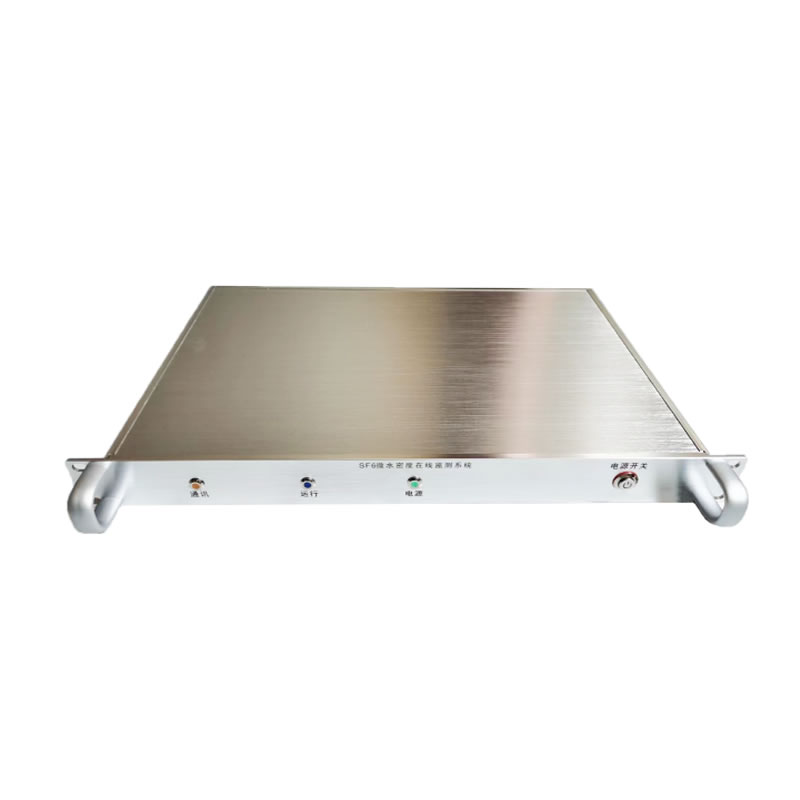
1. Why is temperature compensation important for GIS low-water-content density monitoring?
SF6 gas pressure is affected by temperature; density compensation helps ensure that the data more accurately reflects the actual state of the gas and reduces errors caused by changes in ambient temperature.
1.1 What parameters should be considered for density compensation?
Attention should be paid to whether the three types of data—density, pressure, and temperature—are collected simultaneously and can be displayed as continuous trends in the background.
1.2 What is the value of long-term stability in density data?
Long-term, stable data can serve as a baseline for the gas chamber's condition, making it easier to detect gradual changes later on.
2. How does the accuracy of trace moisture measurement affect GIS projects?
Trace moisture data reflects the moisture content in a gas, and measurement stability can affect the assessment of the gas’s condition later in the project.
2.1 Should we look at real-time values or trends for trace moisture data?
You need both. Real-time values are used to check the current status, while trends are used to observe the direction of changes in moisture content.
2.2 What should be done if there are significant fluctuations in trace moisture data?
Assessments should take into account the sampling interval, temperature fluctuations, and the condition of the equipment to avoid mistaking occasional fluctuations for long-term trends.
| Selection Criteria | Featured Content | Project Value |
| Density Compensation | Pressure, Temperature, and Density Interlock | Determining the State of a Gas |
| Trace Moisture Measurement | Moisture Content and Trends | Assessing the Risk of Moisture Damage |
| Communications Access | Protocol, Refresh Interval, Address | Access Station Backend |
| Installation and Adaptation | Air Chamber Connections and Maintenance Access | Reduce Implementation Difficulties |
3. What should be considered regarding the GIS gas chamber connections and installation locations?
When installing the equipment, take into account the gas chamber connections, maintenance space, and cable routing conditions to avoid difficulties during future maintenance.
3.1 What problems can arise from interface mismatches?
Incompatible interfaces can affect installation efficiency and may also lead to on-site modifications.
3.2 Why Should the Installation Location Be Easily Accessible for Maintenance?
Sufficient working space must be provided for post-installation inspections, communication maintenance, and equipment status checks.
4. How is the SF6 trace moisture density analyzer connected to the substation’s control system?
The device must upload data on density, pressure, temperature, and trace moisture via the agreed-upon communication method. SF6 Gas Trace Moisture and Density Monitoring Device This allows relevant data to be entered into a centralized backend system, facilitating long-term viewing and maintenance.
4.1 What fields should the point table data include?
This should include the equipment name, air chamber location, measurement point name, unit, address, and update time.
4.2 How should the background curve be displayed?
Different data sets should be displayed on separate graphs, but they can also be viewed side by side on the same page.
5. In which scenarios is online GIS low-water-content density monitoring suitable?
Suitable for applications such as GIS and circuit breaker gas compartments where continuous monitoring of the SF6 gas condition is required.
5.1 Are the key considerations the same for new websites and website redesigns?
New sites place greater emphasis on unified planning, while site renovations focus more on interface adaptation and backend compatibility.
5.2 Why Should Multi-Chamber Projects Be Managed Centralized?
Centralized management of multiple air chambers reduces the need for separate inspections and facilitates future inspections and maintenance.
6. What data should be the focus of post-launch maintenance?
Ongoing maintenance should focus on trends in gas density, changes in trace moisture levels, communication status, and the integrity of historical records.
6.1 Why Is Data Completeness Important?
The higher the data completeness rate, the more reliable the long-term trend.
6.2 What is the purpose of the device's online status?
The online status can help distinguish between changes in gas data and communication anomalies.
If you need to configure online monitoring systems for substations, transformers, GIS, switchgear, and other applications, please contact Yinnotongda for technical support. Service Hotline: 13959168359 (same number on WeChat).
Disclaimer: This article is intended solely for technical exchange and reference purposes and should not be used as a basis for on-site operations, equipment modifications, or operational safety assessments. Specific solutions and parameters should be determined based on on-site conditions and official technical documentation.