

Oil-immersed transformer temperature monitoring sensors
Date: August 7, 2025 09:26:43
Oil-immersed transformers use insulating oil as the cooling and insulating medium, and are widely used in the transmission and distribution of power systems. Its operating temperature (especially the winding and oil temperature) directly affects the aging speed of the insulating oil and equipment life, the temperature is too high may lead to oil degradation, insulation breakdown or even fire.temperature sensorAs the core component of oil-immersed transformer condition monitoring, it can capture the temperature change in real time and provide key data for heat dissipation control and fault early warning, which is an important means to ensure the safe operation of the equipment.
First, the special characteristics of oil-immersed transformer temperature monitoring
In contrast to dry-type transformers, temperature monitoring of oil-immersed transformers needs to be adapted to theirOil medium environment, high temperature and high pressure, sealing structureand other characteristics:
- Insulating oil circulates during operation, and the temperature distribution is affected by the oil circulation (the temperature of the top layer is usually higher than that of the bottom layer);
- Winding temperature is the core monitoring indicator, but windings are immersed in oil, making direct measurement difficult (need to penetrate insulation or rely on indirect extrapolation);
- The sensor needs to be resistant to the chemical corrosion of insulating oils (e.g. mineral oil, synthetic oil) and adapt to the temperature range of - 30℃~150℃;
- Some scenarios require explosion-proof design (e.g., sealed spaces such as oil pillows and tanks to avoid spark-induced oil vapor explosions).
Second, the common temperature sensor type and characteristics
Oil-immersed transformer temperature sensors need to take into account the measurement accuracy, environmental adaptability and ease of installation, the common types are as follows:
1. Platinum resistance sensors (Pt100)
principle: Based on the property that the resistance of platinum metal changes linearly with temperature (resistance 100Ω at 0°C), the temperature is converted by measuring the resistance value.
specificities::
specificities::
- High precision (error ≤ ± 0.1 ℃ ~ ± 0.5 ℃), good linearity, suitable for oil temperature, winding surface and other direct contact temperature measurement;
- Stable, long life (up to 10 years or more), can withstand long-term immersion in insulating oil (need to encapsulate corrosion-resistant housing);
- It requires wired transmission, is susceptible to electromagnetic interference (metal shielding wire is required), and is small in size (5~10mm in diameter), suitable for embedding in fuel tanks or oil pillows.
Applicable Scenarios:: - Oil temperature monitoring at the top of the tank (directly immersed in the oil, reflecting the overall state of heat dissipation);
- Surface temperature of the winding (fixed to the outside of the winding by means of an insulating bracket, insulation treatment required).
2. Thermocouple sensors (Type K, Type E)
principle: Two different metals form a circuit and the temperature difference generates a thermoelectric potential (Seebeck effect), which is converted to temperature by the value of the potential.
specificities::
specificities::
- Wide temperature measurement range (-200℃~1300℃), can adapt to the high temperature scenario of transformer short-time overload (such as winding short-time over-temperature to 200℃);
- Simple structure, low cost, vibration and shock resistant, oil corrosion resistant when encapsulated in metal housing;
- Lower accuracy (error ±1℃~±3℃), requires cold-end compensation (ambient temperature affects measurement), and linearity is worse than that of platinum resistors.
Applicable Scenarios:: - Monitoring of non-high-precision needs such as tank bottom oil temperature and core temperature;
- Used as a backup sensor for platinum resistors for redundant monitoring at extreme temperatures.
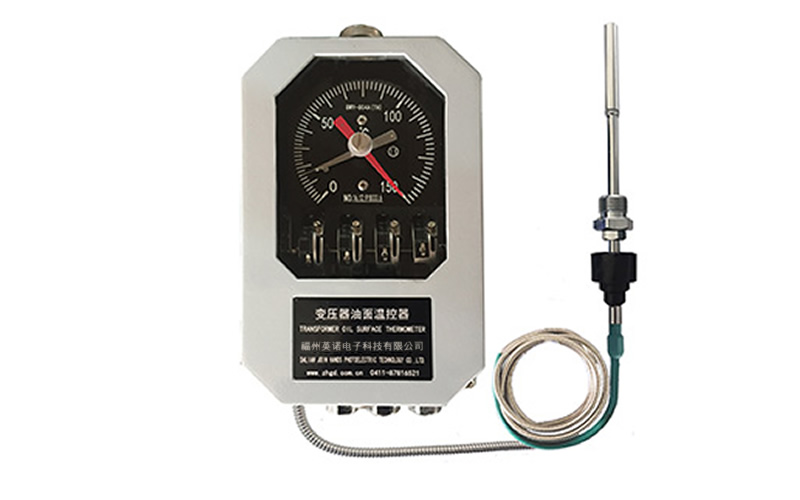
3. Oil temperature controller with built-in sensor (pressure thermometer)
principle: A traditional mechanical temperature measurement device consisting of a temperature packet (temperature sensing element), a capillary tube and a meter head. The temperature package is filled with temperature-sensitive media (e.g., ether, alcohol), which expands/contracts when the temperature changes, transmitting the pressure through the capillary tube and driving the pointer on the gauge head to display the temperature.
specificities::
specificities::
- No power supply required, intrinsically safe (no risk of electrical sparks), suitable for explosion-proof scenarios (e.g. on top of fuel tanks);
- Rugged construction, oil and vibration resistant, easy maintenance (life expectancy of 15+ years);
- Lower accuracy (error ±2℃~±5℃), slow response time (minute level), unable to directly output electrical signals (need to be paired with a contact to realize simple control).
Applicable Scenarios:: - Routine oil temperature monitoring of oil-immersed transformers (especially for small and medium-sized transformers) as a primary means of temperature measurement or as a backup;
- Basic control scenarios where cooling systems (e.g. oil pumps, fans) need to be linked.
4. Fluorescent fiber optic sensors
principleTemperature measurement is achieved by utilizing the "temperature-fluorescence property" of fluorescent materials. The fluorescent material inside the sensor probe emits fluorescence after being excited by a specific wavelength of light (e.g., blue light), and the rate of decay of its fluorescence intensity (lifetime) accelerates with increasing temperature, which can be accurately converted to temperature by detecting the change in fluorescence lifetime.
specificities::
specificities::
- Extremely strong anti-electromagnetic interference ability (fiber optic transmission of optical signals, no conductive parts), fully adapted to the transformer high-voltage side of the strong electromagnetic environment;
- High measurement accuracy (error ≤ ± 0.5 ℃), fast response time (milliseconds), real-time capture of winding temperature fluctuations;
- Resistant to oil corrosion, high temperature (long-term operating temperature - 50 ℃ ~ 200 ℃), the probe is small (diameter ≤ 2mm), can be embedded inside the winding without damaging the insulation;
- Fiber optics are inherently flexible, making it easy to route through the complex structure of a transformer, and intrinsically safe (no risk of electrical sparks) for explosion-proof scenarios.
Applicable Scenarios:: - Direct monitoring of winding hot spots in large oil-immersed transformers (which accurately reflects the highest temperature point of the winding and is the core data for assessing insulation aging);
- Scenarios requiring extremely high measurement accuracy and anti-interference capability (e.g. 220kV and higher grade transformers);
- Where long term stable operation with low maintenance costs is required (fluorescent material life can be more than 10 years).
5. Infrared sensors (non-contact)
principle: Converts temperature by detecting infrared radiation energy on the surface of the device (need to penetrate)oil level meter(Glass or monitor the outside of the tank).
specificities::
specificities::
- Non-contact measurement without breaking the tank seal (suitable for retrofitting old transformers);
- Flexible installation, remote monitoring of the outer wall of the tank, oil pillow oil level surface temperature;
- Higher error (±3℃~±10℃), high influence by environment (e.g. oil level gauge stains, direct sunlight), unable to measure internal temperature.
Applicable Scenarios:: - Complementary to the contact sensors, the overall heat dissipation status of the tank is monitored;
- Older transformers or temporary monitoring scenarios where it is not convenient to install contact sensors.
III. Key monitoring points and installation requirements
The temperature distribution of oil-immersed transformers is closely related to oil circulation and loss distribution, and the core monitoring points and sensor installation need to meet the following requirements:
| monitoring point | Purpose of monitoring | Recommended Sensor Types | Installation Requirements |
|---|---|---|---|
| Top oil temperature | Reflects the overall thermal state of the transformer (the most commonly used indicator). | Pt100, pressure thermometer | Temperature pack / probe immersed in top layer of oil in tank (depth ≥100mm), away from heat sources (e.g. windings) |
| Winding hotspot | Evaluate the rate of insulation deterioration (most hazardous locations) | Fluorescent fiber optic sensor, Pt100 (indirect) | Fluorescent fiber optic probe needs to be embedded inside the winding (pre-embedded in the bobbin gap during manufacture); Pt100 can be converted from top oil temperature + temperature rise (higher error) |
| Core temperature | Monitoring of localized overheating caused by eddy current losses in the iron core | Thermocouple, Pt100 | Fixed to core clamps, insulation package required (to avoid short circuits) |
| environmental temperature | Aids in determining heat dissipation conditions (e.g., high ambient temperature) | Pt100 | Installed 2~3m around the transformer, avoiding direct sunlight. |
IV. Key factors for selection
Selection of oil-immersed transformer temperature sensor, need to be combined with equipment parameters, operating environment comprehensive judgment:
- Temperature range: Covers normal operating temperatures (40°C to 100°C) and short-term overload temperatures (e.g. 120°C to 150°C);
- Precision Requirements: Winding hot spots need to be monitored to within ±1°C (fluorescent fiber optics preferred), top oil temperature can be relaxed to ±2°C (Pt100 is sufficient);
- environmental adaptation: Requires resistance to corrosion by insulating oil (stainless steel package optional), explosion-proof (e.g., Ex dⅡCT4 certification), and waterproof (IP68 protection);
- Installation feasibility: Miniaturized sensors (diameter ≤ 5 mm) are required for embedded windings and matching interfaces (e.g. M27×2 thread) are required for tank mounting;
- Signal compatibility: It needs to be interfaced with thermostat and SCADA system (e.g. 4~20mA, RS485 output) to facilitate remote monitoring and control.
V. Typical configuration of a temperature monitoring system
Temperature monitoring systems for oil-immersed transformers usually consist of "sensor + thermostat + actuator":
- transducers: Capture top oil temperature, winding temperature (direct or indirect);
- thermostat: Receives sensor signals, displays temperature and sets thresholds (e.g. 80°C to start fan, 100°C alarm, 130°C trip);
- actuators: Linkage cooling equipment (oil pumps, fans), automatic start cooling when over-temperature, extreme cases trigger protection tripping.
Note: Large transformers often use a combination of "fluorescent fiber optic direct measurement of the winding + Pt100 measurement of oil temperature", taking into account the accuracy and reliability.
summarize
Temperature sensors for oil-immersed transformers need to be adapted to special environments such as oil medium, high temperature and high pressure.Pt100It is the first choice for top oil temperature monitoring because of the balance of accuracy and cost-effectiveness;Fluorescent Fiber Optic SensorWith the advantages of strong immunity to electromagnetic interference, high accuracy, and the ability to be embedded in the winding, it is ideal for direct measurement of winding hot spots;Pressure thermometerThen it is still widely used in small and medium-sized transformers (intrinsically safe, simple maintenance). The actual selection needs to be combined with the size of the equipment, monitoring objectives and costs, to ensure that the temperature data is accurate and reliable, to provide a guarantee for the safe operation of the transformer.