

How to Choose a Transformer Oil Level Monitoring System? A Comparison of Float-Type, Dial-Type, and Remote Oil Level Gauges
Date: August 14, 2026, 11:47:57
- Standard Pointer-Type Oil Level Monitoring:Suitable for projects requiring on-site, direct reading of the oil level in transformer oil storage tanks and the triggering of fault alarms via high- and low-level contacts. Common models include the YZF2-140TH and YZF2-200.
- Remote Oil Level Monitoring:In addition to mechanical pointer displays and oil level alarms, these devices offer remote transmission functions such as 4–20 mA. A typical product is the YZF3-200 series, which can transmit oil level changes to a control room or other monitoring equipment.
- Comprehensive Online Monitoring:If a project requires continuous oil level data collection and connection to the backend via RS485, the IB-YKTCF-OL/OP three-in-one oil temperature, oil level, and oil pressure monitoring device can be used.
- The float-type and pointer-type are not entirely distinct designs:"Float-type" refers to the oil level sensing method, while "pointer-type" refers to the on-site display method; many YZF series modelsoil level meterIt uses a float sensor combined with a mechanical pointer display.
- When selecting an oil level gauge, don’t just look at the dial diameter:We also need to confirm the oil tank structure, installation location, flange dimensions, connecting rod length, pointer angle, alarm contacts, and whether 4–20 mA or RS-485 remote transmission is required.
I. Why Is It Necessary to Monitor the Oil Level in Oil-Filled Transformers?
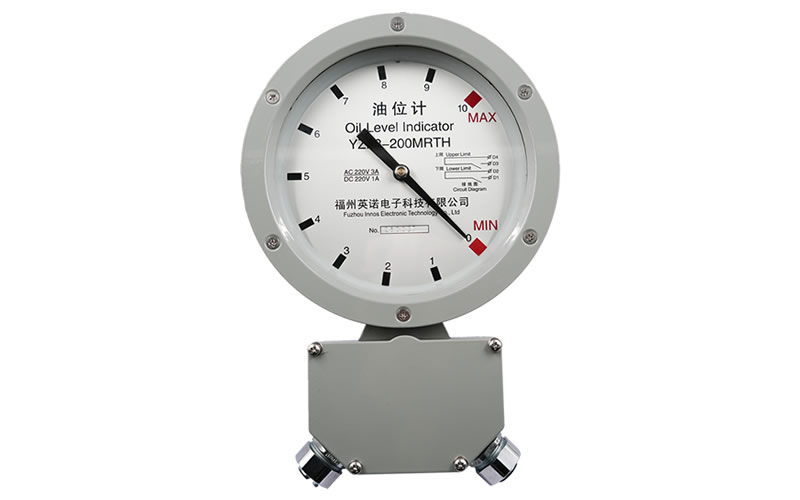
Transformer insulating oil serves to provide insulation, dissipate heat, and protect the internal insulation structure. In oil-immersed transformers equipped with oil reservoirs, the oil level fluctuates to some extent in response to changes in oil temperature, load, and ambient temperature.
The purpose of an oil level gauge is not merely to tell operators “how much oil is left”; more importantly, it helps determine whether the oil level in the storage tank is within the normal operating range.
When the oil level is abnormal, further analysis should be conducted in conjunction with the oil temperature, the condition of the equipment seals, and the operating conditions.
For example, an abnormally low oil level may require an inspection of:
- Is there an oil leak in the transformer?
- Are there any sealing issues with the oil storage tank or piping?
- Have the current ambient temperature and oil temperature dropped significantly?
- Is the float or mechanical transmission mechanism of the oil level gauge stuck?
- Are there any instances of inaccurate oil level gauge readings?
An abnormally high oil level should not simply be interpreted as “too much oil”; it must be assessed in conjunction with changes in oil temperature, the design of the oil reservoir, and actual operating conditions.
II. What are the main methods for monitoring transformer oil levels?
In terms of actual project applications, transformer oil level monitoring can be categorized into several levels: on-site mechanical indicators, remote oil level monitoring, and intelligent integrated online monitoring.
| Monitoring method | Featured Products | Key Features | Applicable Scenarios |
|---|---|---|---|
| Standard Pointer-Style | YZF2-140TH / YZF2-200 | On-site oil level display, high and low oil level alarms | Conventional Oil-Filled Transformers |
| Remote-Read Analog | YZF3-200 Series | Pointer display, alarms, 4–20 mA remote transmission | Substation Automation and Remote Monitoring |
| Comprehensive Online Monitoring | IB-YKTCF-OL/OP | Continuous oil level monitoring, RS-485 communication, multi-parameter monitoring | Smart Power Distribution and Unattended Operation Project |
Therefore, before selecting oil level monitoring equipment, you should first determine exactly what the project requires:
Should we monitor the oil level on-site and trigger an alarm when an anomaly is detected, or should we continuously upload real-time oil level data to the backend?
III. What is the difference between float-type and pointer-type oil level gauges?
When selecting transformer oil level gauges, the terms “float-type” and “dial-type” often appear together, but they actually refer to different aspects.
What is a float-type oil level gauge?
The term "float-type" primarily refers to the method of detecting oil level.
The float is installed inside the transformer's oil reservoir. When the oil level in the reservoir rises or falls, the float moves up and down with the oil surface, and the change in oil level is transmitted outward via a rocker arm and a transmission mechanism.
What is a pointer-type oil level gauge?
"Pointer-type" primarily refers to the method of displaying the oil level.
Changes in the oil level are transmitted to the instrument head via a mechanical transmission mechanism and a magnetic coupling mechanism, which drive the pointer to rotate on the dial, thereby displaying the current oil level.
Therefore, many YZF series products can actually be understood as:
Float sensor + mechanical transmission + magnetic coupling + pointer display + high and low oil level alarms.
For exampleYZF2-140TH Transformer Oil Level GaugeIt is a typical pointer-type oil level monitoring device.
IV. How does the YZF series transformer oil level gauge work?
The YZ Series Pointer-Type Oil Level Gauge for Transformers consists primarily of the following components:
- float
- pendulum
- Mechanical Transmission Mechanism
- Magnetic Coupling Mechanism
- Hands and Dial
- High and Low Oil Level Alarm System
- Mounting Flange
- wiring terminal
The process can be simplified as follows:
Changes in the oil level in the oil tank → The float moves up and down → The rocker arm rotates → Mechanical transmission → Magnetic coupling → The pointer indicates the oil level.
When the oil level reaches the preset high or low oil level alarm thresholds, the internal alarm mechanism is triggered, and an alarm signal is output via electrical contacts.
Why was a magnetic coupling design chosen?
The magnetic coupling mechanism transmits rotational motion between the mechanical drive and the dial indicator, while also helping to isolate the internal components of the oil reservoir from the external instrumentation.
For oil level gauges that are permanently installed on the oil storage tanks of oil-immersed transformers, sealing performance is a critical factor in the product’s reliability.
V. For which transformers is the YZF2-140TH suitable?
YZF2-140TH Oil Level GaugeIt is primarily used for on-site indication of the oil level in power transformer oil storage tanks, and can also output alarm signals when the oil level is too high or too low.
There are many models in the YZF series; common models include:
- YZF2-140
- YZF3-140
- YZF2-175
- YZF2-200
- YZF3-200
- YZF2-250
- YZF3-250
- YZS2-250
- YZF2-140TH
- YZF2-200TH
- YZF3-200TH
- Other Custom Models
The appropriate model should be selected based primarily on the dial size, the angle of hand movement, the oil reservoir diameter, the installation location, the flange size, and the connecting rod length.
VI. Main Technical Specifications of the YZF Series Oil Level Gauges
| Parameter items | Technical Parameter |
|---|---|
| Product Type | Transformer pointer-type oil level meter |
| warning error | Less than 2.5% for the full disk |
| Contact capacity | AC 220 V, 1 A; DC 220 V, 0.3 A |
| environmental temperature | -25°C to +40°C |
| Industrial frequency withstand voltage | 2 kV, 1 min |
| Ambient relative humidity | Not more than 90% (20°C) |
| Sealing performance | 300 kPa, 20 minutes with no leaks |
| protection class | IP55 |
The parameters above are provided as a reference for selecting common YZ Series products. Specific models, alarm configurations, mounting dimensions, and remote transmission capabilities are subject to the actual product configuration.
VII. What is the difference between the YZF2 and YZF3 oil level gauges?
You can’t determine which of the YZF2 and YZF3 is “more advanced” based solely on their model numbers; they differ in terms of pointer travel range, mounting position, and reservoir compatibility, among other factors.
| model number | Dial Diameter | pointer angle | mounting position |
|---|---|---|---|
| YZF2-140 | Ø100 mm | 120° | Center of the oil tank side wall |
| YZF3-140 | Ø100 mm | 270° | Below the side wall of the oil storage tank |
| YZF2-200 | Ø200mm | 120° | Center of the oil tank side wall |
| YZF3-200 | Ø200mm | 270° | Below the side wall of the oil storage tank |
VIII. What is the YZF3-200 Remote Oil Level Gauge?
YZF3-200 Remote Oil Level GaugeUsed for monitoring the oil level in the oil storage tanks of large and medium-sized oil-immersed transformers.
It retains the on-site display function of traditional mechanical pointer-type oil level gauges, while also providing high- and low-oil-level alarms and remote transmission capabilities depending on the configuration.
When should you choose a 4–20 mA level transmitter?
- The control room needs to display the transformer oil level.
- The site is quite far from the control room
- Requires connection to a PLC or RTU
- Comprehensive online monitoring is required
- Unmanned Substations
- We need to track changes in the oil level over time.
IX. What is the difference between 4–20 mA oil level monitoring and RS-485 oil level monitoring?
| Comparison Items | 4-20mA | RS485 |
|---|---|---|
| Signal Type | Analog | Digital Communications |
| typical application | PLC, RTU, Digital Display | Smart Devices, Integrated Online Monitoring Platform |
| Transmission Content | Primarily transmits a single oil level measurement | Transmissible Digital Parameters |
| Multi-Device Networking | Requires a dedicated analog channel | Better Suited for Bus Networking |
X. Under what circumstances should an online oil level monitoring system be selected?
If the project relies solely on manual inspections, the traditional YZF pointer-type oil level gauge is sufficient for on-site oil level display and high/low oil level alarms.
However, when a project requires continuous monitoring of oil level changes, consideration should be given toOnline Transformer Oil Level Monitoring DeviceThe
Online oil level monitoring primarily addresses the following issues:
- View the oil level in real time
- Track Oil Level Trends
- Remote Error Alerts
- Unattended Monitoring
- Combined analysis with parameters such as oil temperature
- Integration with the Comprehensive Online Monitoring Backend
XI. How does the IB-YKTCF-OL/OP perform online oil level monitoring?
If a project requires not only oil level monitoring but also simultaneous monitoring of oil temperature and oil pressure, you can useIB-YKTCF-OL/OP Three-in-One Oil Temperature, Oil Level, and Oil Pressure Monitoring DeviceThe
This device integrates oil temperature, oil level, and oil pressure into a single online monitoring solution and transmits the data via RS-485 to a smart terminal or backend system.
IB-YKTCF-OL/OP Oil Level Monitoring Key Parameters
| Parameter items | Technical Parameter |
|---|---|
| Product Model | IB-YKTCF-OL/OP |
| Monitoring parameters | Oil Temperature, Oil Level, Oil Pressure |
| Oil Level Measurement Range | 0 to 35mm |
| Oil Level Accuracy | ±2mm |
| Oil Level Resolution | 1mm |
| Oil Level Data Update | ≤0.2s |
| communication method | RS485 |
| Mailing Address | 1–247, default 1 |
| Default Baud Rate | 9,600 bps |
| Operating Temperature | -40℃~+70℃ |
| protection class | IP68 |
| operating voltage | DC 12 V–DC 24 V |
XII. How to Choose Between Standard Level Gauges, Remote Level Gauges, and Online Monitoring Systems?
| functionality | Standard YZF Analog | YZF3-200 Remote-Reading Type | IB-YKTCF Online Monitoring |
|---|---|---|---|
| On-site pointer display | be in favor of | be in favor of | Depending on the system configuration |
| High and low oil level alarm | be in favor of | be in favor of | This can be done through the system settings |
| 4-20mA | Based on model configuration | Configurable | The current solution is primarily based on RS-485. |
| RS485 | Requires remote transmission equipment | According to the supporting plan | be in favor of |
| Continuous Data Acquisition | Not included | Once integrated into the system, the following can be achieved: | be in favor of |
| Oil temperature monitoring | unsupported | unsupported | be in favor of |
| Oil pressure monitoring | unsupported | unsupported | be in favor of |
13. What parameters need to be confirmed when selecting a transformer oil level gauge?
Step 1: Determine the type and size of the oil storage tank
Since the oil level gauge is installed on the oil storage tank, the tank’s diameter and internal structure directly affect the length of the float arm and the installation position of the oil level gauge.
- Diameter of the oil storage tank
- Structural Diagram of an Oil Storage Tank
- Oil Level Gauge Installation Location
- Crude Oil Level Gauge Model
- On-site Photos of the Crude Oil Level Gauge
Step 2: Confirm the dial diameter and the angle of the hands
For example, although the YZF2-200 and YZF3-200 both belong to the 200 series, their pointer travel ranges, structures, and mounting positions are not exactly the same.
Step 3: Confirm the dimensions of the mounting flange
- Flange Outer Diameter
- Center-to-Center Dimensions of Mounting Holes
- Number of Bolts
- Bolt Specifications
- Oil Reservoir Opening Dimensions
Step 4: Check the length of the float arm
The float rod must be compatible with the diameter and installation position of the oil reservoir. Depending on the specific structure of the oil reservoir, the length of the float rod can be determined based on actual dimensions or customized.
Step 5: Determine whether high and low oil level alarms are needed
- Low Oil Level Alarm
- High Oil Level Alarm
- Number of contacts
- Contact capacity
- Control Loop Voltage
Step 6: Determine whether remote transmission is required
- 4-20mA analog
- RS-485 Communication
- Matching Digital Display Gauges
- PLC or RTU Input Types
- Backend System Communication Requirements
14. Does a low oil level in a transformer always indicate an oil leak?
Not necessarily. An abnormal oil level is a phenomenon that requires further analysis; the cause of the problem cannot be determined based solely on the oil level gauge.
Check to see if the oil temperature has dropped significantly
The volume of transformer oil changes with temperature. If the ambient temperature or the oil temperature in the equipment drops significantly, the oil level may also drop accordingly.
Check the equipment for oil leaks
Check the fuel tank, valves, flanges, radiator, piping, and connections to the fuel storage tank for any signs of oil seepage or leaks.
Check to see if the float in the oil level gauge is stuck.
If the mechanical transmission is stiff, the rocker arm is jammed, or the float is damaged, the pointer may not accurately track changes in the actual oil level.
Compare on-site oil level data with remote data
If the on-site pointer is functioning normally but the backend display shows an anomaly, you can further inspect the signal lines, the transmitter module, and the backend measurement range settings.
15. What is a false oil level in a transformer?
The term “false oil level” generally refers to a situation where the reading on the oil level gauge does not accurately reflect the actual oil level in the oil tank.
Common areas that require inspection include:
- Float is Stuck
- Float Damaged
- Deformation of the Swing Arm
- Jamming in the Mechanical Transmission Mechanism
- Failure of the Pointer Mechanism
- The oil level gauge is installed in the wrong location
- The internal structure of the oil storage tank affects the movement of the float
- Remote Signal Conversion or Wiring Abnormalities
XVI. Frequently Asked Questions (FAQ) on Transformer Oil Level Monitoring
1. What is the difference between the YZF2-200 and the YZF3-200?
Both are pointer-type oil level gauges for transformers, but the pointer angle and mounting position differ in their standard configurations. When replacing older models, it is also necessary to verify the dimensions of the mounting flange and the float rocker arm.
2. Can the YZF3-200 output 4–20 mA?
Depending on the model and configuration, 4–20 mA analog remote transmission capabilities may be available. When purchasing, specify whether analog output is required and confirm the input method of the backend PLC, RTU, or digital display device.
3. Do pointer-type oil level gauges require a power source to display the level?
Standard mechanical pointer displays primarily rely on a float, a rocker arm, and a mechanical transmission mechanism; basic on-site oil level indication does not depend on a power source for the electronic display. When equipped with remote transmission, digital display, or communication functions, the corresponding electronic components require a power supply.
4. Is a larger oil level gauge dial better?
No. The dial size must be compatible with the original design, the installation space, and the oil reservoir structure; when selecting a model, you should not simply aim for the largest dial.
5. Does a sudden drop in oil level indicate an oil leak in the transformer?
Not necessarily. In addition to oil leaks, you also need to consider factors such as changes in oil temperature, a stuck float, mechanical failures, and abnormal oil level gauge readings.
6. If there is already a mechanical oil level gauge, is online monitoring still necessary?
If on-site manual inspections are the primary method, mechanical level gauges can meet the needs of many routine applications. If unattended operation, continuous data logging, remote alarms, and comprehensive online monitoring are required, remote transmission or online monitoring capabilities can be added.
17. Product features and installation dimensions can be customized
The dimensions, installation locations, flange specifications, and monitoring system interfaces of oil storage tanks may vary among different transformer manufacturers; therefore, transformer oil level gauges can be selected based on specific project requirements, and certain structural and functional configurations can be customized.
Content that can be confirmed or customized based on project requirements includes:
- Oil Level Gauge Model
- Dial Size
- pointer angle
- Flange Installation Dimensions
- Mounting Hole Dimensions
- Float and Rocker Arm Lengths
- High and Low Oil Level Alarm Function
- Alarm Contact Configuration
- 4–20 mA analog output
- Digital Oil Level Gauge
- RS485 Online Monitoring Solution
- Comprehensive Online Monitoring of Multiple Parameters: Oil Temperature, Oil Level, and Oil Pressure
- Replacement of Older Models
- Other Special Installation and Communication Requirements
Need help selecting or customizing a transformer oil level gauge?
If you are unable to identify a suitable product based on the available models, please provide the transformer model, oil tank diameter, crude oil level gauge model, a photo of the nameplate, flange dimensions, float rod length, and the required alarm and remote transmission functions.
For the replacement of old transformer oil level gauges, remote transmission upgrades, 4–20 mA oil level monitoring, RS-485 online monitoring, and special oil tank configurations, please contact us to confirm the specific details.
You can view standard pointer-style products here:YZF2-140TH Transformer Oil Level GaugeThe
If you need remote transmission functionality, please see:YZF3-200 Remote Oil Level GaugeThe
For continuous, comprehensive online monitoring, please see:Three-in-One Oil Temperature, Oil Level, and Oil Pressure Monitoring DeviceThe
XVIII. Summary of Transformer Oil Level Monitoring Device Selection
If the project primarily requiresReal-time oil level reading and high/low oil level alarms... You can choose mechanical pointer-type oil level gauges such as the YZF2 or YZF3.
If you need moreTransmit the oil level signal to the control room, PLC, or RTU...you can choose the YZF3-200 series, which can be configured with 4–20 mA remote transmission capability.
If the project requiresContinuous data acquisition, RS485 communication, and comprehensive online monitoring of oil temperature, oil level, and oil pressure...Online monitoring solutions such as the IB-YKTCF-OL/OP can be used.
When selecting a level gauge, the most appropriate sequence for verification is:
Oil Tank Structure → Installation Location → Dial and Pointer Angles → Flange Dimensions → Float Rod Length → Alarm Function → Remote Transmission Method → Final Product Model.
In particular, for the old oil level gauge replacement project, we recommend providing the original product nameplate, dimensions, and on-site photos to minimize issues related to mismatches in installation interfaces, float lengths, and pointer ranges.
statement denying or limiting responsibility
This article introduces the common operating principles, product types, and selection methods for transformer oil level gauges, remote oil level gauges, and online oil level monitoring systems. It is intended solely for technical exchange and as a reference for product selection, and does not constitute a basis for specific engineering design or a procurement commitment.
Transformer oil storage tanks may vary in terms of structure, installation location, flange dimensions, swing arm length, alarm logic, and communication system requirements. The product models, technical specifications, installation dimensions, output methods, and functional configurations mentioned in this document are subject to the actual product technical documentation, drawings, technical agreements, and final delivery configuration.
When dealing with abnormal transformer oil levels, oil leaks, alarm interlocks, and equipment operational safety, inspections and corrective actions should be conducted in accordance with the transformer manufacturer’s technical requirements, on-site operational data, and relevant project specifications.