
How to choose the best manufacturer of dry-type transformer thermostats
Date: July 20, 2025 17:20:28
Dry-type transformer thermostatfunctional requirement
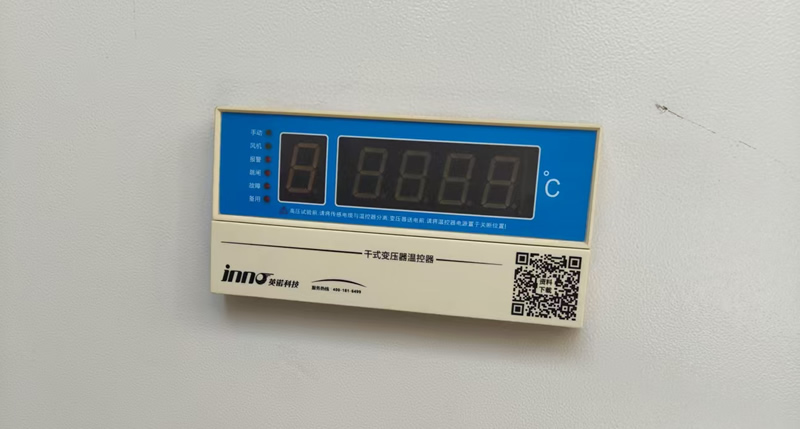
- Accurate temperature measurement: Use of high precision PT100 or PTC sensors (usually 3-6 or more as standard).
- Reliable fan control: Automatically starts and stops the cooling fan according to a set threshold (usually 1-2 outputs).
- Over-temperature alarm: Signal (relay output) when the temperature reaches the preset alarm threshold.
- Over-temperature tripping: When the temperature reaches the danger threshold (usually 10-20°C higher than the alarm), a trip signal is issued to cut off the power supply to the transformer to prevent damage (relay output).
- Temperature display: Clear display of the real-time temperature of each phase of the winding (usually maximum or cyclic display).
- Setting value adjustment: Allows the user to adjust the thresholds for alarms, trips, and fan start/stop based on transformer specifications and environment.
- Sensor failure monitoring: Can detect sensor open or short circuit faults and issue alarms.
- High reliability and long life: Designed for power equipment, it can operate stably for a long period of time in industrial environments.
Factors for the best dry-type transformer thermostat
- Transformer model and size: Larger transformers may require more sensor inputs and more complex control logic.
- Application Environment:
- Ambient temperature: Extreme high or low temperature environments.
- Humidity/dust/corrosion: Whether a higher level of protection is required (e.g. IP65).
- Electromagnetic interference: Strong electromagnetic environments require better anti-interference design.
- Explosion-proof requirements: Special environments require ATEX or IECEx certification.
- Functional Requirements:
- Remote monitoring and communication: Do I need Modbus RTU (RS485), Profibus, Ethernet/IP, CANopen, etc. to access the SCADA/DCS system?
- Data logging: Is it necessary to record historical temperatures, alarm events?
- Analog output: Is a 4-20mA or 0-10V output temperature signal required?
- Three-phase temperature is displayed simultaneously: Is it necessary to see all three phase temperatures at the same time on the panel?
- Thermal simulation modeling: Advanced models can simulate/predict the hottest point temperature based on load and ambient temperature.
- Multi-stage fan control: For multiple sets of fans, is hierarchical control required?
- User Interface:
- Display clarity: LED, LCD or large dot matrix LCD?
- Ease of operation: Pushbuttons, knobs or touchscreen? Are the menus intuitive?
- Brands and Services:
- Brand Reputation: Market share, user reputation, industry experience.
- Quality Certification: CE, UL, CSA, RoHS, etc.
- Technical support and spare parts: Is localized service and spare parts supply timely and convenient?
- Product line compatibility: Compatibility with existing systems or future expansion.
- Budget: High-end features usually mean a higher price.
How to choose the "best" for your dry-type transformer thermostat manufacturers
- Clarify core needs: Must-have features (e.g., several sensors, fan control, communication interface), desired features (e.g., thermal simulation, data logging), application environment (protection level).
- Consider the budget: Choose the cost-effective one while meeting your core needs.
- Evaluate brands and services: Which brand has the best service and spare parts support in your area? Does your client or project have a brand preference?
- Refer to real-world use cases: Know the brands and models commonly used for the same type of transformer or similar operating conditions.
- Consult the vendor: Provide the specific model, size, application environment and your needs for the transformer, so that the professional supplier can recommend the specific model and give the configuration plan.
- Focus on certification: Ensure that the product complies with project or regional safety standards and certification requirements (e.g. CE, UL).
Final Recommendation: There is no absolute "best", only the "most suitable". Be sure to make a comprehensive evaluation based on your specific transformer parameters, application environment, functional requirements and budget. Before purchasing, check the product manuals in detail and communicate with reliable suppliers to confirm.