
Oil-immersed Transformer Condition Monitoring Device: Core Functions, Selection Points and Application Guidelines
Date: March 20, 2026 17:43:17
- Oil-immersed transformer condition monitoring device is a special equipment for real-time collection, analysis and early warning of transformer operation status.
- By monitoring key parameters such as oil temperature, oil level, partial discharges, dissolved gases, etc., the risk of failure can be significantly reduced.
- Online monitoring is more capable of realizing continuous, real-time status mastery than offline detection, and is suitable for use in important places.
- When selecting the model, it is necessary to comprehensively consider the monitoring parameters, installation conditions, communication methods and implementation of standards and other factors.
- Inotera provides professional condition monitoring solutions for oil-immersed transformers for a wide range of application scenarios.
First, what is an oil-immersed transformer condition monitoring device?
Oil-immersed transformer condition monitoring device is a kind of intelligent instrument and equipment specially designed for oil-immersed transformer operation status to carry out real-time monitoring, data collection and abnormal warning. It continuously collects temperature, oil level, insulation status, gas content and other key data through various types of sensors installed on the transformer body or accessories, and transmits these data to the back-end system for analysis and judgment, thus helping operation and maintenance personnel to grasp the health status of the equipment in a timely manner.
Oil-immersed transformers are widely used in power systems, industrial and mining enterprises, rail transportation, data centers and other places, is the core equipment in power transmission and distribution. Due to its long-term operation in high-pressure, high-temperature environment, the internal insulating oil and insulating materials will be gradually aging with time, if not effectively monitored, once the failure occurs, not only affect the reliability of power supply, but also may cause serious safety accidents.
Therefore, equipping a set of reliable condition monitoring devices is an important means to ensure the safe and stable operation of the transformer.
Second, why do oil-immersed transformers need condition monitoring?
Many users will have this question: the transformer itself already has a protective relay, why do you need an additional condition monitoring device? The positioning of the two is actually fundamentally different.
The protective relay is in faultpost-eventFast action, cut off the circuit, belongs to the "after the fact protection"; while the condition monitoring device is in the failure of thepre-occurrenceThe first signs of anomalies are detected as "advance warning".
The following points illustrate the need for condition monitoring:
- Transformer failures often have precursors:Problems such as insulation aging, partial discharges, and oil deterioration often have days or even weeks of abnormal signals before they cause serious failures, and monitoring devices can capture these early characteristics.
- Regular outages are costly to maintain:Traditional offline inspection requires power outage operations, affecting production and power supply. Online monitoring can continuously grasp the status of equipment without power outage and optimize the maintenance plan.
- Critical equipment must not "run sick":For hospitals, data centers, railroads and other power supply sensitive places, any omens need to be responded to in a timely manner, and condition monitoring is the most direct means of protection.
- Meet the requirements of power industry standards:The State Grid, Southern Power Grid and related industry standards have clear requirements for online monitoring of important transformers.
Third, oil-immersed transformer condition monitoring device can monitor what parameters?
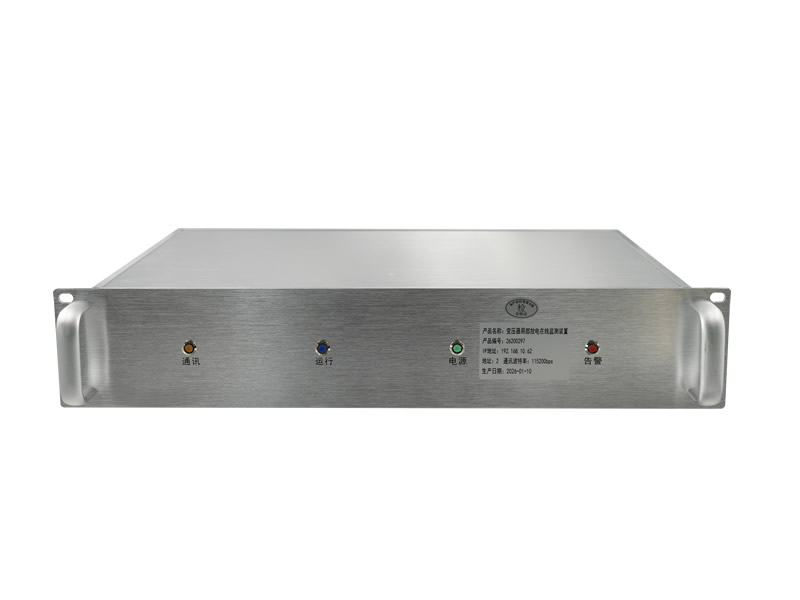
completeOil-immersed transformer condition monitoring deviceThe following categories of core parameters can usually be covered, each corresponding to a different type of failure and basis for risk judgment.
| Monitoring parameters | Monitoring method | Corresponding risk type | degree of importance |
|---|---|---|---|
| Top oil temperature | temperature sensor | Overload, abnormal heat dissipation | ★★★★★ |
| Winding Temperature | Fiber optic thermometry or thermal modeling | Overheating of windings, deterioration of insulation | ★★★★★ |
| oil level | oil level meter/Level Sensor | Oil leakage, insufficient oil | ★★★★☆ |
| Dissolved gas (DGA) | Online Oil Chromatography Analyzer | Internal discharge, overheating, moisture | ★★★★★ |
| partial discharge(PD) | Ultrasonic/UHF transducers | Insulation defects, discharge degradation | ★★★★★ |
| Core ground current | current transformer | Multi-point grounding of the iron core | ★★★★☆ |
| Casing dielectric loss | Dielectric Loss Sensor | Sleeve insulation deterioration, moisture | ★★★★☆ |
| On-load tap-changer status | Travel switches/vibration sensors | Switch mechanical failure | ★★★☆☆☆ |
| Ambient temperature and humidity | Temperature and humidity sensors | External environmental impact assessment | ★★★☆☆☆ |
Among them.Dissolved Gas Analysis (DGA)Recognized by the industry as one of the most effective means of determining latent faults within a transformer, it is capable of identifying a wide range of fault types including partial discharge, overheating, and moisture, and is the core functional module of the advanced monitoring device.
IV. What is the difference between online monitoring and offline testing?
When choosing a monitoring method, users are often confused about which is more appropriate, online or offline. Both have their own characteristics and are applicable to different scenarios, the following table makes a visual comparison.
| comparison dimension | Online monitoring | offline testing |
|---|---|---|
| Monitoring continuity | 24/7 real-time monitoring | Regular testing with intervals |
| Whether a power outage is required | No blackout required | Some projects require power outages |
| Data timeliness | Real-time data, abnormal immediate alarm | Large lag time, may miss early abnormalities |
| O&M costs | Higher initial investment, save labor later | Low initial costs, but ongoing investment in labor costs |
| Applicable objects | Critical transformers, unattended stations | Non-critical lines, small distribution transformers |
| Data logging | Automatic storage of historical trends | Reliance on manual records, difficult to trace |
| remote access | Supports remote viewing and alarm push | Usually not supported |
Taken together.Online monitoring is more suitable for power main transformers, industrial critical loads and unattended substations.and other scenarios; offline testing is suitable as a complementary means for sites that do not have online monitoring conditions or for periodic in-depth inspections.
V. Working principle of oil-immersed transformer condition monitoring device
The working principle of oil-immersed transformer condition monitoring device is not complicated, can be summarized as "perception - transmission - analysis - early warning" four links.
Step 1: Perception
Sensors installed in various parts of the transformer continuously collect data on physical quantities, such as temperature, vibration, gas concentration, electrical quantities, and so on. Different sensors use different measuring principles, such as fiber optic sensors for winding temperature measurement, ultrasonic sensors for local discharge detection, and electrochemical sensors for gas analysis.
Step 2: Transmission
The collected raw data is transmitted to the local pooling unit or to a cloud server via wired (RS485, Ethernet) or wireless (4G/5G, LoRa). Modern devices usually support multiple communication protocols at the same time and are compatible with standard interfaces such as IEC 61850 and Modbus.
Step 3: Analyze
The background system performs real-time calculations and historical trend analysis on the received data, combining with the preset threshold model or diagnostic algorithm to determine whether the current equipment status is in the normal range.
Step 4: Early warning
Once the abnormality is detected, the system immediately triggers an alarm, notifies the relevant personnel through SMS, APP push, sound and light alarms, and generates a fault report to provide a basis for O&M decision-making.
VI. What do I need to pay attention to when installing this device?
Proper installation is a prerequisite for reliable operation of the monitoring device. The following are a few key considerations:
1. Sensor mounting position
Temperature sensors should be installed at the top of the transformer tank, as close as possible to the oil layer; local discharge sensors need to be fixed on the outside of the box wall, to avoid metal blockage affecting the signal; oil chromatography on-line device to avoid the accumulation of air bubbles in the oil pipeline, the pipeline direction to be maintained gently.
2. Electromagnetic compatibility
The electromagnetic environment around the transformer is complex, the signal cable should be shielded, and keep a sufficient distance from the strong power lines to avoid interference resulting in data distortion.
3. Protection level requirements
Outdoor installation of the device should be selected IP65 and above protection level, in high humidity, high salt spray or extreme temperature environment, need to further confirm the applicable temperature range of the device and anti-corrosion treatment.
4. Grounding
The grounding of the monitoring device should be reliably connected to the main ground network of the transformer to prevent measurement errors or equipment damage caused by ground potential differences.
5. Commissioning and acceptance
After the installation is completed, full-parameter intermodulation should be carried out to confirm that the data of each sensor coincide with the actual value, the communication link is smooth, and the alarm function is normal before it is put into use.
VII. How to choose the right monitoring device according to the actual needs?
Faced with products on the market with different features, many users don't know how to start. The following selection comparison table can help quickly sort out the needs.
| application scenario | Recommended monitoring features | Recommendations on means of communication | Protection level requirements |
|---|---|---|---|
| 110kV and above main transformer | DGA + Local Discharge + Oil Temperature + Casing Loss + Core Current | Fiber/Ethernet | IP55 and above |
| 35kV Industrial Transformer | Oil Temperature + Oil Level + DGA + Local Discharge | RS485 / 4G | IP54 and above |
| 10kV Distribution Transformer | Oil temperature + oil level + core current | 4G / LoRa | IP54 and above |
| Unattended substations | Full parameter monitoring + remote video linkage | 4G/5G + Ethernet | IP65 and above |
| Data Center/Hospital Distribution | Oil Temperature + Local Discharge + DGA + Alarm Linkage | Ethernet/RS485 | IP54 and above |
In addition to the above dimensions, the following points should be focused on when selecting a model:
- Whether standard protocols are supported:Priority is given to products that support standard protocols such as IEC 61850, Modbus TCP, etc., which are easy to integrate with existing SCADA or dispatching systems.
- Manufacturer service capabilities:Including local installation and commissioning, remote technical support, spare parts supply, etc., the perfect after-sales system is the long-term stability of the use of the guarantee.
- Certifications and Qualifications:Products should have relevant type test reports, power industry testing and certification to ensure compliance with the actual use of standards.
Eight, oil-immersed transformer condition monitoring of the relevant standards and norms
Oil-immersed transformer condition monitoring field has formed a relatively perfect standard system, in the selection and implementation of the project need to refer to the implementation. The following are the main standards in common use:
- GB/T 7595--Quality standard for transformer oil in operation, which specifies the requirements for limits of dissolved gases in the oil.
- DL/T 722-Guidelines for the analysis and determination of dissolved gases in transformer oil, which are the core basis for DGA diagnosis.
- DL/T 1498--Transformer Condition Evaluation Guidelines, which specify the scoring method for each condition quantity and the comprehensive evaluation process.
- GB/T 4703-Partial Discharge Measurement Standard for the calibration and testing requirements of local discharge sensors.
- IEC 60076-7--Oil-immersed transformer loading guidelines covering temperature limits and thermal modeling calculation methods.
- Q/GDW 11304--State Grid Enterprise Standard, which details the technical requirements for online transformer monitoring devices.
In the project bidding and acceptance process, it is recommended that suppliers be explicitly required to provide a statement of compliance with the relevant standards to ensure that the product's technical specifications are consistent with the standard requirements.
IX. Common Failure Early Warning and Treatment
The core value of a condition monitoring device is to detect problems in advance. Below are several types of common abnormal signals and their corresponding handling recommendations:
1. Persistently high oil temperatures
Possible causes: overload operation, radiator blockage, cooling system failure. Treatment suggestion: checkCooling Fans/Water-cooled system operating status, verify load levels and operate at reduced loads if necessary.
2. Elevated concentration of dissolved gases (H₂, CH₄, C₂H₂)
Possible cause: Internal partial discharge or overheating. The presence of acetylene (C₂H₂) usually indicates an internal arc discharge, which is a high-risk signal and should be stopped immediately for inspection.
3. Sudden increase in local discharges
Possible causes: moisture insulation, degradation of insulating oil, presence of air gap defects. Handling suggestions: Combine with DGA data to make comprehensive judgment, arrange oil sample testing and precision diagnosis.
4. Continuing decline in oil levels
Possible causes: Oil leakage, broken oil reservoir capsule. Handling suggestions: on-site inspection to confirm the leakage point, timely replenishment of oil and repair of sealing defects.
5. Abnormal core grounding current
Possible cause: Iron core multi-point grounding or insulation damage. Handling suggestions: Arrange for a power outage inspection, measure the insulation resistance of the iron core, and troubleshoot the grounding circuit.
X. Why do more and more users choose Inotera monitoring devices?
Among the many providers of condition monitoring solutions for oil-immersed transformers, theInnoTechWith its specialized product system and rich engineering experience, it has gained the trust and choice of more and more users.
Specialized in power equipment monitoring
Inotera is deeply engaged in the field of power equipment condition monitoring, the product line covers oil temperature monitoring, oil level monitoring, partial discharge detection, dissolved gas on-line analysis and other core monitoring modules, and is able to provide targeted solutions for different sizes and voltage levels of transformers, rather than a "one-size-fits-all" generic product.
Conforms to mainstream standards and is highly compatible
Designed in strict accordance with DL/T 1498, Q/GDW 11304 and other industry standards, Inotera monitoring devices support IEC 61850, Modbus TCP, MQTT and other communication protocols, and can be seamlessly accessed to the State Grid, the South China Network dispatching system and third-party operation and maintenance platforms, with flexible deployment and convenient access.
Perfect after-sales service system
From pre-project program consulting, installation and commissioning guidance, to remote technical support and regular maintenance after commissioning, INNOTEC provides full life-cycle service guarantee to help users truly realize the goal of "monitoring, good use and convenient maintenance".
Suitable for a wide range of applications
Whether it is 110kV substation main transformer, 35kV industrial special transformer, or data centers, hospitals, rail transit and other places with extremely high requirements for power supply reliability, Inotera has mature implementation cases with rich on-site experience accumulation.
If you are looking for a reliable condition monitoring solution for oil-immersed transformers, welcome to contact INNOTEC for professional selection advice and customized solutions.
statement denying or limiting responsibility
The content of this article is for reference only, and is intended to provide a general introduction to the knowledge of oil-immersed transformer condition monitoring device. The technical parameters, standards and application recommendations in this article do not constitute the only basis for any project implementation or procurement decisions. The actual project should be combined with specific equipment models, site conditions and related standards, by professional and technical personnel to assess and confirm. The author and publisher of this article shall not be liable for any direct or indirect losses arising from reference to the contents of this article.